The post Types of Disabilities: A Clear Guide with Examples appeared first on Studyhub.
]]>A normal day can feel safe and predictable. However, one small barrier can change everything. A crowded space becomes overwhelming. Written instructions feel confusing. Movement feels painful or slow. As a result, everyday tasks take more effort. Moreover, the worry of being judged adds pressure. Therefore, support and understanding become essential. Disabilities are long-term conditions that affect how people move, learn, communicate, or cope with daily life. In the UK, many disabilities are visible, while others are hidden. This guide explains the types of disabilities clearly and respectfully. It also shares real examples to help build awareness, inclusion, and confidence for everyone.
Table of Contents
What Are Disabilities?
Disabilities are long-term conditions that affect how people move, think, learn, or communicate. However, disability is not only about health. It is also shaped by the world around us. For example, a step without a ramp can limit access. Similarly, loud spaces can cause stress. As a result, daily activities may feel harder. In the UK, millions of people live with a disability. Many are visible, while others are not. Therefore, understanding disabilities means looking at both the person and their environment. When barriers are reduced, independence and confidence improve for everyone.
Types of Disabilities Explained
The types of disabilities are often grouped by how they affect life. However, real life can be more complex. Some conditions are visible. Others are hidden. Moreover, many people experience more than one type.
At a glance: the main types of disabilities
Physical disabilities
Sensory disabilities (vision and hearing)
Intellectual disabilities
Mental health–related disabilities
Neurological disabilities
Developmental disabilities
Hidden (invisible) disabilities
Therefore, these categories help communication and planning. In addition, they support better access at school and work. Finally, understanding the types of disabilities reduces stigma. It also improves inclusion in UK communities.
Physical Disabilities
What is a physical disability?
A physical disability affects movement, strength, or physical function. However, the impact depends on the person and setting. For example, stairs without a ramp can limit access. Meanwhile, fatigue can also reduce ability. Therefore, support often includes mobility aids and accessible design.
Common examples of physical disabilities
Mobility impairment after injury
Cerebral palsy
Arthritis that limits movement
Muscular dystrophy
Limb difference or amputation
Spinal cord injury
Chronic pain conditions that reduce function
How physical disabilities can affect daily life
Daily tasks may take more time. Moreover, public transport can be harder without step-free routes. In addition, some people need rest breaks. Therefore, flexible schedules and accessible spaces help. That is why many guides on types of disabilities include physical needs early.
Sensory Disabilities
Sensory disabilities affect how people see, hear, or process sensory input. However, many adjustments are simple. For example, captions help hearing access. Likewise, good contrast helps navigation.
Visual impairments
Visual impairment can range from low vision to blindness. Moreover, lighting and glare can change what feels usable. Therefore, large print, screen readers, and clear layouts matter.
Hearing impairments
Hearing loss can be mild or profound. In addition, background noise can reduce understanding. Therefore, captions, hearing loops, and clear speech help access.
Examples of sensory disabilities
Partial sight or blindness
Colour vision difference
Tinnitus that affects focus
Deafblindness
These examples show why types of disabilities should include communication access.
Intellectual Disabilities
What are intellectual disabilities?
Intellectual disabilities affect learning, reasoning, and everyday problem solving. However, ability varies widely. Moreover, support works best when it is personalised. Therefore, clear instructions and patient pacing help.
Examples of intellectual disabilities
Down’s syndrome
Intellectual disability linked to genetic conditions
Intellectual disability linked to brain injury
Support and accessibility considerations
Support may include structured routines and easy-read information. In addition, consistent support staff can help. Therefore, inclusive teaching and workplace practices matter. Courses on disability awareness can strengthen this approach.

Learning Disabilities
Learning disabilities are often confused with intellectual disabilities. However, they are different. Learning disabilities affect how information is processed. Meanwhile, general intelligence can be average or above.
Difference between learning and intellectual disabilities
Learning disabilities affect specific skills. For example, reading or writing may be harder. Intellectual disabilities affect broader reasoning and daily living skills. Therefore, the types of disabilities need both categories.
Common learning disabilities
Dyslexia (reading and spelling)
Dyspraxia (coordination and planning)
Dyscalculia (numbers and maths)
ADHD (attention and impulse control)
The NHS explains learning disabilities as lifelong learning differences.
Examples in education and work settings
In school, reading-heavy tasks can take longer. In addition, note-taking can be difficult. Therefore, extra time and assistive tools help. At work, clear written steps and checklists support performance. For teaching strategies, Studyhub’s learning-focused training can help staff.
Mental Health–Related Disabilities
Mental health conditions can affect daily life in ways others cannot see. Simple tasks may feel heavy. Concentration may fade quickly. Energy can drop without warning. As a result, work, study, and social life may suffer. Moreover, fear of judgement often stops people from asking for help. Therefore, understanding mental health–related conditions as part of the types of disabilities is essential in the UK. Clear language, empathy, and awareness reduce stigma and improve access.
When mental health conditions are considered disabilities
Mental health conditions may be classed as disabilities when they have a long-term and serious effect on daily activities. This includes challenges with focus, communication, routine, or emotional regulation. However, not every condition is the same. The impact must be ongoing and significant. In the UK, guidance focuses on how the condition affects everyday life, not just the diagnosis. This approach helps ensure fair treatment without forcing people to explain personal details.
Examples of mental health–related disabilities
Some mental health conditions can become disabling when symptoms are persistent. Common examples include:
Severe depression that affects motivation and routine
Anxiety disorders that limit social or work participation
Bipolar disorder with long-term mood disruption
Post-traumatic stress disorder affecting safety and focus
Obsessive-compulsive disorder interfering with daily tasks
These examples show how mental health fits within broader types of disabilities, especially when support is limited.
Workplace and everyday recognition
Support at work can make a real difference. Flexible hours allow recovery time. Clear expectations reduce pressure. Quiet spaces help focus. Therefore, thoughtful adjustments improve confidence and performance. In the UK, many organisations now recognise mental health as part of inclusive practice. This shift helps people remain active in education and employment while managing long-term conditions.
Neurological Disabilities
What are neurological disabilities?
Neurological disabilities affect the brain, spinal cord, or nerves. However, symptoms can change day to day. Therefore, consistent support and flexible planning matter.
Examples of neurological disabilities
Multiple sclerosis
Epilepsy
Parkinson’s disease
Migraine with significant impact
Stroke-related disability
Visible vs invisible neurological conditions
Some neurological conditions are visible. Others are hidden. Moreover, fatigue and pain may not show. Therefore, people may need adjustments even without obvious signs. This is why modern types of disabilities guides include “invisible impact.”
Developmental Disabilities
What are developmental disabilities?
Developmental disabilities begin in childhood. They can affect communication, learning, and daily skills. However, people develop strengths and coping skills too. Therefore, supportive environments matter.
Examples of developmental disabilities
Autism spectrum condition
Global developmental delay
Conditions affecting social communication
Differences between childhood and adult support needs
Support in childhood often focuses on education. Meanwhile, adult support often includes work and independence. Therefore, transitions need planning. Courses that explore disability studies can improve inclusive thinking.
Hidden (Invisible) Disabilities
What are hidden disabilities?
Hidden disabilities are conditions that are not obvious. However, they can still limit daily life. For example, fatigue can end plans early. Meanwhile, sensory overload can cause distress. Therefore, kindness and belief matter.
Common examples of invisible disabilities
Chronic fatigue conditions
Fibromyalgia
Some neurological conditions
Diabetes complications
Epilepsy between seizures
Why awareness matters in the UK
In the UK, many services rely on self-advocacy. Therefore, awareness helps reduce judgement. In addition, workplaces can plan better adjustments. Training in disability awareness and inclusion supports this shift.
Different Types of Disabilities and How They May Overlap
People can have multiple disabilities. Moreover, one condition can affect several areas. Therefore, categories should guide support, not label people.
Multiple disabilities
A person may have mobility limits and hearing loss. In addition, fatigue can affect both work and learning. Therefore, support plans should combine adjustments.
Co-existing conditions
Autism and anxiety may occur together. Likewise, ADHD can overlap with dyslexia. Therefore, the types of disabilities may blend in real life.
Why clear categories still matter
Categories help schools plan support. They also help employers design adjustments. Therefore, they remain useful. Yet, they should stay flexible.
Examples of Disabilities in Everyday Life
At school
Noise can block focus. Meanwhile, reading-heavy tasks can overwhelm. Therefore, extra time and clear instructions help. In addition, assistive tools can improve learning.
At work
Bright lights and open offices can cause stress. Moreover, long meetings can reduce attention. Therefore, structured breaks and clear tasks help. Training on Disability & SEN can support staff confidence.
In public spaces
Crowds can trigger anxiety. In addition, unclear signage can block independence. Therefore, accessible design matters. These examples make the types of disabilities feel real.
Table: Types of disabilities, examples, and helpful supports
Types of disabilities | Examples | Helpful supports (UK-friendly) |
Physical | Arthritis, spinal injury | Step-free access, flexible pacing |
Sensory | Deafness, low vision | Captions, hearing loops, clear contrast |
Intellectual | Down’s syndrome | Easy-read, structured routines |
Learning | Dyslexia, dyspraxia | Extra time, assistive tech, checklists |
Mental health | Depression, PTSD | Flexible hours, clear expectations |
Neurological | MS, epilepsy | Rest breaks, quiet space, safety planning |
Developmental | Autism | Predictable routines, sensory adjustments |
Hidden | Chronic fatigue | Trust, flexibility, reduced stigma |
Therefore, a good guide to types of disabilities always pairs examples with supports.
Summary
The types of disabilities are best understood as categories of support needs. However, people do not fit neat boxes. Therefore, use categories with care. Physical and sensory disabilities often need access changes. Learning and intellectual disabilities often need clear teaching support. Mental health and neurological disabilities may need flexibility and reduced stress. Moreover, hidden disabilities need trust and understanding.
If you want to build skills for inclusive practice, Studyhub offers UK-relevant training. For example, disability awareness training supports teams. In addition, disability assessor training supports those moving into assessment roles. Finally, learning disability nursing has clear UK career pathways and salary ranges.
Final note: This guide explains types of disabilities for learning and inclusion. For legal definitions, use GOV.UK.
FAQs
Common categories include physical, sensory, learning, intellectual, mental health–related, neurological, developmental, and hidden disabilities. Therefore, the main types of disabilities cover both visible and invisible needs.
No. Many disabilities are hidden. For example, chronic fatigue and anxiety may not show. Therefore, it helps to avoid quick judgement.
Yes, they can be. However, this depends on impact and duration. For UK workplace guidance, ACAS explains disability under the Equality Act.
Not always. Some disabilities are lifelong. Others may change over time. Therefore, support should stay flexible.
The post Types of Disabilities: A Clear Guide with Examples appeared first on Studyhub.
]]>The post Difference Between a Barrister and a Solicitor (UK Explained) appeared first on Studyhub.
]]>Court delays and legal backlogs have become a regular topic in the UK. As cases take longer and legal costs rise, people are paying closer attention to how the justice system works. Many now ask who actually handles legal matters behind the scenes. Some professionals prepare cases quietly, while others speak in court. This confusion often leads to one important question: what is the difference between barrister and solicitor? Understanding this difference helps people make better legal and career decisions. Therefore, this guide explains everything clearly, using plain UK English.
Table of Contents
Understanding the UK Legal System
The UK legal system separates legal responsibilities carefully. This structure exists to maintain high professional standards. Because of this separation, legal roles are clearly defined. However, many people still misunderstand who does what.
In simple terms, the system divides preparation work and courtroom advocacy. Solicitors manage cases from the start, while barristers focus on courtroom arguments. This separation has existed for centuries and continues today. As a result, understanding the system is the first step to understanding the difference between barrister and solicitor.
This distinction protects clients, courts, and legal outcomes. Therefore, clarity matters.
What Is a Solicitor?
A solicitor is usually the first legal contact. Therefore, most legal journeys start here. Solicitors manage cases from beginning to end. However, they rarely argue in higher courts.
Solicitors focus on preparation, advice, and communication. They work closely with clients and ensure legal matters progress smoothly. Because of this, their role demands organisation and clarity.
Typical responsibilities of a solicitor include:
Advising clients on legal options and risks
Drafting contracts and legal documents
Managing conveyancing and property transactions
Negotiating settlements and agreements
Preparing evidence and case files
Instructing barristers when court advocacy is required
Because solicitors remain client-facing, communication skills matter deeply. This client-focused role forms a key part of the difference between barrister and solicitor.
If you want structured solicitor training, StudyHub offers a dedicated course:
https://studyhub.org.uk/course/solicitor/
What Is a Barrister?
Barristers specialise in courtroom advocacy. Therefore, their work looks very different. They usually receive instructions from solicitors. However, their responsibility level remains high.
Barristers focus on legal argument and interpretation. They prepare opinions, analyse case law, and present arguments before judges. Because of this, courtroom confidence is essential.
Typical responsibilities of a barrister include:
Representing clients in higher courts
Presenting oral legal arguments
Drafting specialist legal opinions
Interpreting complex legislation and case law
Cross-examining witnesses
Advising solicitors on legal strategy
Because of this advocacy focus, barristers train differently. This distinction sits at the heart of the difference between barrister and solicitor.
Education and Training Pathways
Although both roles require legal education, training routes differ early. This difference shapes future work styles and responsibilities.
Solicitors qualify through the Solicitors Qualifying Examination (SQE). This route includes practical work experience and professional assessments. It focuses on real-world legal application and client care. Official guidance is available from the Solicitors Regulation Authority: https://www.sra.org.uk/become-solicitor/sqe/
Barristers follow a different route. After academic training, they complete the Bar Practice Course and a competitive pupillage. This process focuses heavily on advocacy skills and courtroom readiness. Official information is provided by the judiciary:
https://www.judiciary.uk/about-the-judiciary/judges-career-paths/
Because training paths differ, they clearly reflect the difference between barrister and solicitor in practice.

Work Environment and Daily Routine
Daily work environments vary greatly between these roles. This difference affects lifestyle, workload, and stress levels.
Solicitors usually work in law firms or corporate offices. Their days involve meetings, emails, document preparation, and client discussions. While deadlines exist, schedules are often predictable. This environment suits those who prefer structure and stability.
Barristers, however, work around court schedules. Their days depend on hearings, case preparation, and travel. Court sessions can be intense and unpredictable. Therefore, flexibility and resilience are essential. This contrast further highlights the difference between barrister and solicitor.
Rights of Audience in Court
Court access marks a key distinction. Not all lawyers can argue in every court.
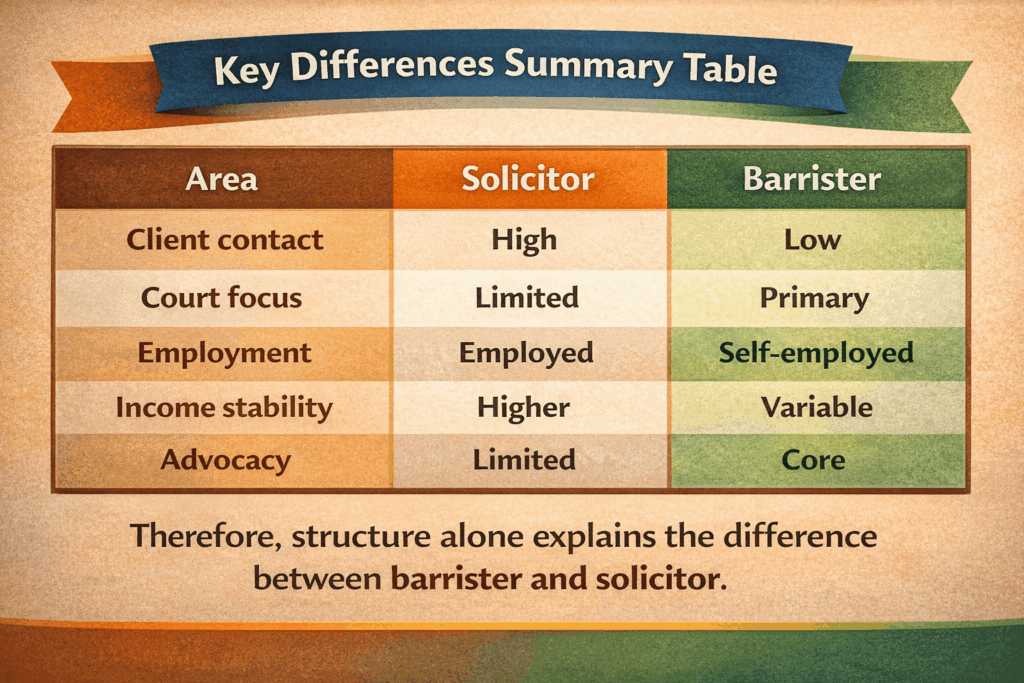
Court Level | Solicitor | Barrister |
Magistrates’ Court |
|
|
County Court |
|
|
Crown Court | Limited |
|
High Court | Limited |
|

Official source:
https://www.gov.uk/government/organisations/hm-courts-and-tribunals-service
Therefore, courtroom rights clearly explain the difference between barrister and solicitor.
Client Interaction Differences
Client access varies greatly. This difference affects trust and communication.
Solicitors deal directly with clients throughout a case. They explain progress, outline options, and manage expectations. Because of this, they maintain strong client relationships.
Barristers usually work behind the scenes. Although direct access exists in limited cases, solicitors remain the main contact. This difference in interaction further highlights the difference between barrister and solicitor.
Salary Comparison in the UK
Income varies based on experience, location, and role. However, official data shows clear patterns.
Solicitors often earn stable salaries. Entry-level roles start modestly, while experienced solicitors earn higher wages. Solicitor salary (UK – National Careers Service) provides guidance:
https://nationalcareers.service.gov.uk/job-profiles/solicitor
Barristers experience wider income variation. Early earnings can be low, especially during pupillage. However, senior barristers can earn significantly more. Barrister salary (UK – National Careers Service): https://nationalcareers.service.gov.uk/job-profiles/barrister
Thus, income structure reinforces the difference between barrister and solicitor.
Career Stability and Risk Levels
Career security differs between these professions. This factor often influences career decisions.
Solicitors usually work as employees. They receive steady income, benefits, and predictable progression. This stability appeals to those seeking long-term security.
Barristers operate as self-employed professionals. Income depends on reputation and case volume. While potential rewards are high, financial risk remains greater.
Because of this contrast, risk tolerance defines another difference between barrister and solicitor.
Skills Required for Each Role
Both roles demand high standards and constant professional development. However, the skills required for each path differ in focus and daily use. Understanding these skill differences helps explain how solicitors and barristers contribute in distinct ways. It also helps individuals choose a role that suits their strengths. This contrast further highlights the difference between barrister and solicitor beyond formal training routes.
Solicitor skills
Organisation
Solicitors manage multiple cases at the same time. Therefore, strong organisation is essential. They track deadlines, documents, and communications to ensure cases progress smoothly and without delay.Client communication
Solicitors communicate regularly with clients. They explain legal options clearly and manage expectations throughout a case. As a result, clear and calm communication builds trust and confidence.Negotiation
Many legal matters settle outside court. Because of this, solicitors negotiate agreements, contracts, and settlements. Strong negotiation skills help resolve disputes efficiently and cost-effectively.Case management
Solicitors oversee cases from start to finish. They coordinate evidence, instruct barristers, and monitor progress. This role requires planning, attention to detail, and consistent follow-through.
Barrister skills
Public speaking
Barristers present arguments in court. Therefore, confident and clear public speaking is essential. They must explain complex legal points persuasively to judges and juries.Legal analysis
Barristers interpret legislation and case law in depth. They analyse legal principles and apply them to specific cases. This analytical skill supports strong courtroom arguments.Confidence under pressure
Courtrooms can be intense environments. Barristers often respond to unexpected questions or challenges. Staying calm under pressure allows them to adapt quickly and defend their position effectively.Argument construction
Barristers build structured legal arguments. They organise facts, law, and reasoning into clear submissions. This skill helps courts understand the case clearly and reach informed decisions.
In summary, solicitors rely on organisation, communication, and coordination, while barristers depend on advocacy, analysis, and courtroom presence. These contrasting skill sets reinforce the difference between barrister and solicitor and explain why each role remains essential within the UK legal system.
Final Thoughts
Choosing the right legal career depends on personal strengths, work preferences, and long-term goals. Some people prefer structured roles with steady client contact and ongoing case management, while others are drawn to courtroom advocacy and independent legal debate. Understanding the difference between barrister and solicitor helps clarify which path aligns best with individual skills and expectations. Alongside these roles, related legal routes such as conveyancing offer practical, property-focused career options for those interested in transactional law. Ultimately, the UK legal system relies on clearly defined professional responsibilities to maintain quality and fairness. As legal services continue to evolve and demand grows, making informed career and legal choices becomes increasingly important. Therefore, knowing who does what within the legal profession remains essential for confident decision-making.
FAQs
Neither role is more powerful overall. Solicitors control case management and client decisions, while barristers hold authority in higher court advocacy. Their power lies in different responsibilities.
No. In the UK, they are separate legal roles. Solicitors manage cases and advise clients, while barristers specialise in courtroom advocacy and legal argument.
British lawyers are not all called barristers. The term “barrister” refers specifically to advocates who argue cases in court, historically separated from solicitors.
Yes. A solicitor can retrain as a barrister by completing the Bar training course and pupillage, subject to meeting entry requirements.
It depends on experience and success. Solicitors usually earn more early on due to stable salaries, while senior barristers can earn significantly more at higher levels.
The post Difference Between a Barrister and a Solicitor (UK Explained) appeared first on Studyhub.
]]>The post Careers After Teaching: Best Alternative Jobs for Teachers appeared first on Studyhub.
]]>A few months ago, new workforce updates again showed teaching pay improving across the UK. Yet, daily workload pressure still dominates staffroom conversations. As a result, many teachers quietly start planning a change. They still value learning, purpose, and impact. However, they now want calmer days, clearer boundaries, and sustainable routines. If you are exploring careers after teaching, you are certainly not alone. Across the country, professionals with classroom experience are rethinking how their skills fit into wider roles. This guide focuses on practical options, realistic UK salary ranges, and a clear transition path. Moreover, it avoids hype and false promises. Instead, it offers grounded advice that respects your experience, your time, and your need for a balanced, achievable next step.
Table of Contents
Quick Snapshot of Careers After Teaching
Before you choose, you need a clear overview. Therefore, here is a fast map of where teachers commonly move.
Typical directions (UK):
People development roles in organisations.
Project and programme coordination roles.
Data and insight roles, with upskilling.
Public sector policy and service roles.
Digital learning and content roles.
Simple “where people go” pie chart (illustrative)
(This is a guide, not a survey.)
					People Development / Training   ████████████ 30%
Project / Programme             ████████     20%
Data / Insight                  ██████       15%
Civil Service / Public Services █████        15%
EdTech / Content / UX           █████        15%
Other                           ██           5%
To be clear, careers after teaching work best when you pick a lane. Then, you build proof.
Why Careers After Teaching Can Be a Strong Move
This section matters because mindset drives outcomes. Also, it helps you explain your decision professionally.
Key reasons teachers succeed after teaching:
Already manage complexity. Lessons, behaviour, and deadlines train you well.
Communicate for a living. So, you can explain hard ideas simply.
Coach people daily. Therefore, training and leadership roles fit naturally.
Track progress. Marking builds strong feedback and measurement habits.
Stay calm under pressure. Consequently, you handle change well.
Still, the smartest approach is structured. So, treat careers after teaching like a project. Define a goal, collect evidence, and move in stages. You are not “starting over”. Instead, you are repackaging real skill.
What Employers Want: a clear “skills translation”
Many teachers lose time here. They list duties, not outcomes. However, employers buy outcomes.
Your teaching skills, translated
Use these phrases in your CV and LinkedIn. Also, use them in interviews.
Curriculum planning → project planning, stakeholder alignment, scope control
Differentiation → user-centred design, customer segmentation, accessibility thinking
Assessment → quality assurance, performance measurement, insight reporting
Parent communication → client communication, expectation management, escalation handling
Pastoral care → people support, coaching, safeguarding awareness, risk awareness
When you position yourself this way, careers after teaching become easier to access. Moreover, you stop competing with graduates. Instead, you compete with experienced professionals. Clarity beats confidence. Therefore, write your skills in business language.
Best Alternative Jobs for Teachers in the UK
Now the practical part. Each role below fits careers after teaching because it uses your core strengths. Also, each includes a government salary source.
Comparison table: roles, fit, salary, and “proof”
(Salary ranges come from UK government-backed career profiles.)
Role (UK) | Why teachers fit | Typical “proof” to show | Salary range (UK) |
Training Officer (L&D) | You plan learning and coach adults | 1 short training session + slides | £24k–£40k (nationalcareers.service.gov.uk) |
Business Project Manager | You organise people and deadlines | Simple project plan + timeline | £29k–£75k (nationalcareers.service.gov.uk) |
IT Project Manager | You manage delivery and change | Basic agile board + project case | £35k–£60k (nationalcareers.service.gov.uk) |
Data Analyst-Statistician | You track progress and trends | 2 dashboards + short insight note | £23k–£62k (nationalcareers.service.gov.uk) |
Data Scientist | You solve problems with logic | 1 portfolio project + GitHub | £32k–£82.5k (nationalcareers.service.gov.uk) |
Civil Service Manager | You lead teams and services | STAR examples + leadership proof | £35k–£70k (nationalcareers.service.gov.uk) |
These roles are popular because they match careers after teaching with realistic entry routes.

Role-by-Role Guidance for Careers after Teaching
Below you’ll find short, usable advice for each path. Each mini-section has an intro and a close, so you can act on it.
1) Training Officer (Learning & Development)
If you enjoy mentoring staff and running CPD, this is a natural step. Moreover, it keeps you close to education without classroom pressure.
How to break in:
Build a 30-minute workshop on a topic you know well.
Deliver it online to a small group.
Gather feedback and improve it.
Why it ranks for you: Your classroom delivery becomes adult training delivery.
Salary (UK): £24,000 to £40,000.
For careers after teaching, this is one of the fastest wins.
2) Business Project Manager
This route suits you if you like plans, timelines, and clear outcomes. Also, schools are already project environments.
How to break in:
Learn basic project terms: scope, risk, milestones.
Create a one-page project plan from a school initiative.
Practise explaining trade-offs in plain language.
Salary (UK): £29,000 to £75,000.
If you want careers after teaching with strong progression, this is it.
3) IT Project Manager
This is similar to business project work. However, it focuses on digital delivery and change. Therefore, it suits teachers who enjoy systems and tools.
How to break in:
Run a simple “tech rollout” plan, even as a mock project.
Learn agile basics: backlog, sprint, stand-up.
Translate classroom outcomes into product outcomes.
Salary (UK): £35,000 to £60,000.
For careers after teaching, this is powerful if you like tech.
4) Data Analyst-Statistician
If you enjoy patterns, tracking, and reporting, this is a strong option. Also, it is more accessible than many think.
How to break in:
Learn spreadsheets properly, then basic SQL.
Build two dashboards from public datasets.
Write a short insight summary for each.
Salary (UK): £23,000 to £62,000.
Careers after teaching often accelerate once you show evidence.
5) Data Scientist
This is a longer path. However, it can pay well and scale fast. So, it suits teachers who enjoy maths, logic, and modelling.
How to break in:
Start with Python basics and data projects.
Build one end-to-end portfolio project.
Explain your process clearly, not perfectly.
Salary (UK): £32,000 to £82,500.
For ambitious careers after teaching, this can be a high ceiling route.
6) Civil Service Manager
Many teachers want stability and purpose. Therefore, public service roles can fit well. Also, leadership experience transfers strongly.
How to break in:
Use the STAR method for examples.
Focus on outcomes, not effort.
Learn the role’s behaviours and tailor answers.
Salary (UK): £35,000 to £70,000.
How to apply: Use the official Fast Stream guidance if relevant. (civil-service-careers.gov.uk)
Careers after teaching often feel meaningful in public service.
A practical 30–60–90 Day Plan for Careers After Teaching
A plan reduces anxiety. Also, it stops endless scrolling. Therefore, follow this timeline.
Days 1–30: Choose and simplify
Pick one target role.
Write a “skills translation” paragraph.
Collect 6 strong STAR examples.
Update your CV headline to match the role.
In careers after teaching, focus beats motivation.
Days 31–60: Build proof
Create one small project each week.
Publish your work as a simple portfolio.
Ask two people for feedback.
Proof ideas (quick and realistic):
Training role: 1 workshop deck + evaluation form.
Project role: 1 plan + risk log + timeline.
Data role: 1 dashboard + insights note.
Proof makes careers after teaching feel “real” to employers.
Days 61–90: Apply with precision
Apply to 8–12 roles that match your profile.
Tailor the first half-page of your CV.
Rehearse answers using role behaviours.
Where to get official career guidance: The National Careers Service has tools and job profiles.
Consistency lifts results in careers after teaching.
How Studyhub Fits into Careers after Teaching
Training helps, but it must be targeted. Therefore, use Studyhub to close one skills gap. Also, avoid collecting random certificates.
Smart ways to use Studyhub:
Choose a pathway that matches your role.
Build a portfolio piece after each module.
Convert learning into outcomes and evidence.
Examples:
For training roles: presentation skills, instructional methods, and evaluation basics.
For project roles: project planning, stakeholder management, risk control.
For data roles: Excel, SQL basics, data storytelling.
Studyhub supports careers after teaching when you turn learning into proof.
Salary Reality Check and Official Context
Salaries vary by sector and location. Also, role scope changes pay fast. So, always cross-check figures.
Useful official references:
Teacher pay and conditions documents. (GOV.UK)
England workforce statistics and pay summaries. (Explore Education Statistics)
UK earnings benchmarks. (Office for National Statistics)
In careers after teaching, salary grows with scope and evidence.
Closing thoughts
Leaving teaching is not failure. Instead, it is a career decision. Moreover, many teachers move into better-balanced work and still serve others. Careers after teaching work best when you choose one direction, build proof, and apply consistently. So, take one step today. Then take the next tomorrow. With a focused plan and the right training support from Studyhub, careers after teaching can become your strongest professional chapter.
FAQs
Yes, if you choose one target role. Also, you must build proof weekly. Therefore, focus on one path.
Usually, no. However, you need role-relevant evidence. So, show projects, not just certificates.
Then choose adjacent careers after teaching, like training roles. Moreover, tutoring and content roles can help.
The post Careers After Teaching: Best Alternative Jobs for Teachers appeared first on Studyhub.
]]>The post 10 Reasons to Become a Teaching Assistant (TA): Career Guide & Tips appeared first on Studyhub.
]]>In the UK, there are over 280,000 teaching assistants (TAs) working in state-funded schools, making it one of the largest support roles in the education sector. As class sizes grow and inclusive education becomes more important, schools increasingly rely on teaching assistants to support both teachers and students. This rising demand has made the role a stable and accessible career choice across primary, secondary, and SEN settings.
In many classrooms across the country, teaching is no longer carried out by one person alone. A teaching assistant plays a vital role in supporting learning by helping students who need extra attention while the teacher delivers lessons or works with other pupils. By providing one-to-one or small-group support, teaching assistants help create a more effective and inclusive learning environment. Understanding why many people choose this career can help you decide whether becoming a teaching assistant is the right path for you.
In this article, we explain what a teaching assistant is, outline 10 key reasons to become a teaching assistant, and share practical tips on how to start a career in this growing profession.
What Is a Teaching Assistant (TA)?
A teaching assistant (TA) is an education support professional who works alongside teachers in schools to help students learn and thrive. Teaching assistants support classroom activities, provide one-to-one or small-group help, and assist with lesson preparation, behaviour management, and student supervision. Their role allows teachers to focus on delivering lessons while ensuring that every learner receives the attention they need.
Teaching assistants work across early years, primary, secondary, and special educational needs (SEN) settings. In many cases, a teaching assistant for SEN offers tailored support to pupils with additional learning, behavioural, or physical needs, helping to create an inclusive learning environment. With recognised teaching assistant qualifications—such as a teaching assistant course level 3 or teaching assistant (TA) training online—individuals can enter this growing profession and build a rewarding career in education.
Boost your career in education with the Level 3 Teaching Assistant Diploma from Studyhub – learn online and get certified fast!
10 Great Reasons to Choose a Career as a Teaching Assistant (TA)
Teaching assistant jobs continue to grow in demand as schools look for skilled professionals to support teachers and learners. A teaching assistant works closely with students, helping them succeed academically, socially, and emotionally. Whether you are considering a new career or upskilling through a teaching assistant level 3 course, this role offers stability, purpose, and progression.
If you are exploring jobs for teaching assistant roles, here are ten strong reasons why this career could be right for you.
1. Every Day Is Different
One of the biggest benefits of teaching assistant (TA) jobs is the variety. Your daily teaching assistant (TA) duties may include supporting lessons, assisting with classroom activities, or working one-to-one with pupils. This variety keeps the role engaging and ensures no two days are the same, especially in diverse classroom settings.
2. Gain In-Demand Skills Through Training
Completing courses for teaching assistant (TA) roles helps you build valuable skills such as communication, behaviour management, and organisation. Many learners choose a teaching assistant course level 3 or teaching assistant training online to gain recognised teaching assistant qualifications that schools value highly.
3. A Highly Rewarding Role
Teaching assistants play a direct role in student success. Whether you work as a general classroom assistant or as a teaching assistant (TA) for SEN, helping learners overcome challenges brings real job satisfaction. This sense of achievement is a key reason many people stay long-term in teaching assistant jobs.
4. Make a Real Difference to Learners
Supporting students individually or in small groups allows you to tailor your approach to their needs. A teaching assistant for SEN often provides essential support to learners with additional needs, helping them build confidence and achieve their goals in an inclusive environment.
5. Clear Career Pathways
Starting with a teaching assistant level 3 course can open doors to further opportunities in education. Many people use teaching assistant online courses as a stepping stone into higher roles, teacher training, or specialised SEN support positions. The job description often allows room for professional growth.
6. A Wide Range of Responsibilities
Teaching assistant duties extend beyond classroom support. You may help prepare learning materials, supervise activities, track progress, and support behaviour management. This varied teaching assistant job description makes the role ideal for those who enjoy hands-on work and teamwork.
7. Enjoy a Healthy Work-Life Balance
Most teaching assistant jobs follow school hours and term-time schedules. This makes jobs for teaching assistant roles appealing for parents, carers, or anyone seeking predictable hours. Teaching assistant pay varies by experience and location, but the work-life balance is often a major advantage.
8. Learn From Experienced Teachers
Working alongside qualified teachers gives you access to mentoring and professional guidance. This experience is particularly valuable if you are completing a teaching assistant for the course or preparing for teaching assistant interview questions when applying for future roles.
9. Use Your Interests in the Classroom
Many schools value teaching assistants who bring creativity, sports, or artistic interests into learning. These strengths can enhance your role, especially when supported by teaching assistant training online or specialist courses for teaching assistant development.
10. Be Part of a Supportive School Community
Teaching assistants are essential members of the school team. Whether you work in mainstream education or as a teaching assistant for SEN, you become part of a community focused on student success. With growing demand, teaching assistant jobs offer long-term career security.
Access the course library of 3000+ courses for just £149 for a lifetime!
Preparing for Teaching Assistant (TA) Jobs
To succeed in jobs for teaching assistant roles, it’s important to gain recognised teaching assistant qualifications. Completing a teaching assistant course level 3 or enrolling in teaching assistant online courses improves your employability and confidence. Many candidates also prepare by reviewing common teaching assistant interview questions and understanding the full teaching assistant job description before applying.
With the right training and commitment, teaching assistant jobs offer a fulfilling and stable career in education. Here is a guideline on how you can become a qualified Teaching Assistant:
How to Become a Teaching Assistant (TA)
The post 10 Reasons to Become a Teaching Assistant (TA): Career Guide & Tips appeared first on Studyhub.
]]>The post How to Become a Teaching Assistant (TA) appeared first on Studyhub.
]]>Teaching Assistants (TAs) play an essential role in the education system, acting as the backbone of classroom support. While teachers plan lessons and manage the overall learning environment, TAs ensure that students receive the personalised attention they need to thrive academically, socially, and emotionally.
In the UK, the demand for qualified TAs is growing steadily. According to recent reports, there are over 300,000 teaching assistants employed across England alone, and the number is expected to rise as schools focus on improving student support and inclusion. This increasing demand makes becoming a teaching assistant a promising and rewarding career choice for individuals passionate about education and child development.
Table of Contents
What is a Teaching Assistant?
A Teaching Assistant is an educational professional who works alongside teachers to support classroom activities and student learning. Their role goes beyond simply helping students with homework or lesson tasks; TAs are integral to the smooth running of classrooms and the academic development of students.
Key Responsibilities of a Teaching Assistant
- Assisting teachers in preparing learning materials and classroom resources.
- Supporting students individually or in small groups, particularly those who need additional help.
- Helping manage classroom behaviour and maintain a positive learning environment.
- Monitoring student progress and providing feedback to teachers.
- Supporting students with special educational needs (SEN) or disabilities.
Boost your career in education with the Level 3 Teaching Assistant Diploma from Studyhub – learn online and get certified fast!
Types of Teaching Assistants
General Classroom TAs: Assist with day-to-day classroom activities, helping a range of students with learning tasks.
Special Educational Needs (SEN) TAs: Work with students who have learning difficulties, disabilities, or conditions such as autism, ADHD, or dyslexia.
Higher-Level Teaching Assistants (HLTAs): Take on additional responsibilities such as leading lessons, supervising other TAs, or coordinating support across classrooms.
TAs bridge the gap between teachers and students, providing personalised support that allows learners to reach their full potential. Their presence is especially critical for children who require more attention due to learning difficulties, language barriers, or emotional challenges.
Qualifications Needed to Become a TA
While teaching assistant roles can sometimes be accessible without formal qualifications, having recognised credentials greatly enhances employability and career progression.
Educational Requirements for Teaching Assistants
At minimum, most schools in the UK require GCSEs in English and Maths.
Some schools may prefer candidates with A-levels or equivalent qualifications.
Important Certifications
Level 3 Teaching Assistant Diploma: One of the most widely recognised qualifications for aspiring TAs, this diploma equips candidates with essential skills for classroom support, SEN awareness, and child development understanding.
SEND Courses: Certificates focusing on Special Educational Needs, Autism, ADHD, and Dyslexia help TAs work effectively with students who have specific learning challenges.
Optional Qualifications
Courses in phonics, behaviour management, and early years education can further enhance employability.
First aid and safeguarding certifications are highly valued by schools and educational institutions.
Completing these qualifications not only improves your chances of securing a TA role but also prepares you for more specialised positions such as SEN TA or HLTA.
Here are a few other courses you may take a look for competing for the challenging yet demanding and lucrative Teaching Assistant jobs:
Key Skills Required for Becoming a Teaching Assistant
Being a successful TA requires a combination of personal and professional skills. These include:
Communication and Interpersonal Skills
Clear verbal and written communication with teachers, students, and parents.
Ability to explain concepts in an understandable way.
Active listening to respond to students’ needs effectively.
Patience and Empathy
Working with students requires understanding that every child learns differently.
Patience helps in supporting students with learning difficulties without frustration.
Empathy allows TAs to build trust and a safe learning environment.
Classroom Management and Organisational Skills
Maintaining order and structure during lessons.
Preparing and organising learning materials efficiently.
Monitoring student behaviour and supporting teachers in disciplinary matters.
Knowledge of Teaching Methods and Support Strategies
Understanding different learning styles and adapting support accordingly.
Familiarity with strategies for SEN students, including assistive technologies or differentiated instruction.
TAs who develop these skills not only make a significant impact on students’ learning but also gain recognition for their professionalism within the school.

Career Path and Growth Opportunities for Teaching Assistants
The career path for teaching assistants is flexible, offering multiple opportunities for growth.
Entry-Level Roles
General classroom support roles are the most common entry point.
Many TAs start part-time before progressing to full-time positions.
Specialisations and Progression
SEN TA: Focuses on students with special educational needs, often requiring additional training and qualifications.
Lead TA / HLTA: Takes on leadership responsibilities, supervises other TAs, and may run lessons independently.
Specialist Roles: Some TAs specialise in early years education, literacy support, or behaviour management.
Further Study and Career Advancement
Completion of a Level 3 Teaching Assistant Diploma can open doors to higher-level roles.
Additional professional development courses in SEN, educational psychology, or leadership can lead to positions such as SEND Coordinator or even teacher training pathways.
With experience and qualifications, TAs can build a long-term career in education, transitioning into leadership roles or pursuing teaching qualifications to become fully qualified teachers.
Salary Expectations
Salary for teaching assistants in the UK varies depending on experience, location, and qualifications.
Average Salary: Entry-level TAs typically earn between £14,000 and £17,000 per year.
Experienced TAs or HLTA: Salaries can rise to £20,000–£25,000 annually, with some specialist SEN roles paying even higher.
Factors Affecting Pay
Location: Schools in London and the South East tend to offer higher salaries due to cost-of-living adjustments.
Experience and Qualifications: Accredited courses and years of experience increase earning potential.
Type of Role: SEN TAs or HLTAs often earn more due to additional responsibilities and skills required.
Investing in accredited courses such as the Level 3 Teaching Assistant Diploma can not only improve career prospects but also directly impact salary potential.
How to Gain Experience
Gaining practical experience is crucial for becoming a successful teaching assistant.
Volunteering
Many schools welcome volunteers to assist in classrooms, offering firsthand exposure to teaching practices.
Volunteering builds confidence and helps develop key skills like classroom management and student support.
Internships or Placements
Some educational programmes include placement opportunities in schools.
Internships allow you to observe teaching techniques, assist with lesson delivery, and understand school policies.
Online and Remote Courses
Online courses provide flexible learning while gaining recognised qualifications.
Remote learning is especially helpful for working adults or those balancing other responsibilities.
Experience, combined with formal qualifications, makes candidates highly attractive to schools and educational institutions.

Step-by-Step Guide to Becoming a TA
Becoming a teaching assistant is straightforward if approached methodically:
Research Roles and Schools: Identify the type of TA role that interests you and the schools or educational institutions in your area.
Gain Relevant Qualifications: Complete essential courses like the Level 3 Teaching Assistant Diploma and optional SEN certifications.
Apply for Positions: Prepare a strong CV highlighting relevant skills, qualifications, and experience. Tailor your applications to the job description.
Prepare for Interviews: Be ready to demonstrate knowledge of teaching methods, classroom management, and experience with students.
Engage in Continuous Professional Development (CPD): Attend workshops, webinars, or further courses to enhance skills and stay current with educational trends.
Following these steps increases your chances of securing a TA position and building a fulfilling career in education.
Recommended Courses
For those serious about becoming a teaching assistant, enrolling in accredited courses can fast-track career progression.
Studyhub Level 3 Teaching Assistant Diploma: Covers essential skills for classroom support, SEN awareness, child development, and professional practice.
Specialist SEN Courses: Certificates in Autism, ADHD, Dyslexia, and SEND provide practical strategies to support diverse learners.
Benefits of Online Learning
Flexibility to learn at your own pace.
Access to updated materials and teaching methods.
Immediate application of skills in current or future classroom roles.
Enhances employability and increases potential for higher salaries and specialised roles.
Studyhub’s online courses are designed for working professionals and newcomers to education, making them an ideal choice for aspiring TAs.
Access the course library of 3000+ courses for just £149 for a lifetime!
Conclusion
Teaching assistants are vital to the educational system, providing the support that enables students to thrive academically, socially, and emotionally. With the growing demand for TAs in the UK, now is an ideal time to consider this career path.
By gaining the right qualifications, developing essential skills, and building practical experience, anyone with a passion for education can succeed as a TA. Courses like Studyhub’s Level 3 Teaching Assistant Diploma and specialist SEN certifications provide the knowledge and confidence needed to excel.
Taking the first step—whether it’s enrolling in a course, volunteering in a school, or exploring available positions—can set you on a rewarding career path where you make a lasting impact on students’ lives.
FAQ’s
To work as a TA, the minimum requirement is usually GCSEs in English and Maths. However, completing a recognised qualification, such as the Level 3 Teaching Assistant Diploma, is highly recommended. Optional courses in SEND, Autism, ADHD, and Dyslexia can also enhance your skills and employability.
Teaching Assistants support teachers and help students in the classroom. Key tasks include:
Assisting with lesson preparation and classroom resources.
Supporting students individually or in small groups.
Helping manage classroom behaviour and creating a positive learning environment.
Supporting students with special educational needs (SEN) or disabilities.
Monitoring student progress and providing feedback to teachers.
Minimum: GCSEs in English and Maths.
Recommended: Level 3 Teaching Assistant Diploma.
Optional but valuable: Certificates in SEN, Autism, ADHD, Dyslexia, phonics, safeguarding, and first aid.
Yes, you can start as a TA with little or no prior experience, especially if you have relevant qualifications. Volunteering in schools or completing online TA courses can help you gain practical experience and improve your chances of securing a paid role.
The post How to Become a Teaching Assistant (TA) appeared first on Studyhub.
]]>The post Highest Paying Jobs in the World (2026) – Job-Ready Career Paths appeared first on Studyhub.
]]>Pay headlines keep shifting in the UK. Meanwhile, bills stay high and savings feel tighter. Therefore, more people rethink careers with fresh urgency. They want stability. They also want growth that lasts. However, degrees take time, cost money, and delay income. So, many now chase the highest paying jobs in the world through faster, job-ready routes. As a result, skills, proof, and practical pathways matter more than labels. This guide keeps it practical and grounded. It focuses on UK paths that employers recognise. Moreover, it shows clear skills to build step by step. Additionally, it links pay to real job profiles and responsibilities. Finally, it helps you choose a route that fits your goals, timeline, and risk level—so you can move forward with confidence.
Table of Contents
Quick Reality Check Before you Start
The highest paying jobs in the world usually share three things. First, they solve expensive problems. Second, they carry real risk. Third, they need scarce skills. However, “highest paid” can mean different things. It can mean high base pay. It can also mean bonuses. Therefore, treat pay as a range. That is safer than chasing one number.
Also, UK pay varies by region. London often pays more. Yet costs are higher too. So, compare lifestyle value, not only salary. Moreover, aim for skills that travel globally. That is how many people reach the highest paying jobs in the world.
For context, the ONS tracks UK earnings through ASHE. It reports median hourly pay for full-time staff.
UK Salaries and Job-Ready Career Paths
Below is a fast comparison. Salaries are UK ranges from the National Careers Service.
Role (UK) | Typical salary range | Why it links to high pay | Job-ready path (UK-friendly) |
Barrister | £21k–£200k | High-stakes advocacy | Legal foundations + advocacy practice |
Solicitor | £30k–£80k | Complex legal value | Legal training + case work skills |
Airline pilot | £47k–£150k | Safety + responsibility | Ground school + flight training plan |
Surgeon | £39k–£145k | Specialist clinical risk | Long route, but clear milestones |
Dentist | £53k–£112k | Skilled clinical service | Structured training, practical focus |
Software developer | £30k–£75k | Global demand | Portfolio + real projects |
IT project manager | £35k–£60k | Delivery under pressure | PM tools + stakeholder skills |
Data analyst-statistician | £23k–£62k | Decisions powered by data | SQL + dashboards + storytelling |
Financial adviser | £27k–£67k | Client outcomes + trust | Compliance basics + planning skills |
Actuary | £32k–£70k | Risk pricing | Maths + modelling pathway |
Management consultant | £27k–£60k | Efficiency gains | Problem solving + presentation |
Architect | £31k–£58k | Design and delivery | Portfolio + planning knowledge |
This table frames the highest paying jobs in the world using UK data. Next, we make it actionable.
How People Actually Reach High Pay
Many readers want a clear map. Think of this as a simple flow chart::
Skills → Proof → Responsibility → Pay
Skills are what you learn.
Proof is what you can show.
Responsibility is what you are trusted with.
Pay follows responsibility.
This ladder matters because the highest paying jobs in the world rarely reward potential alone. Instead, they reward proof. So, your plan must create proof quickly.
Role-by-Role Guide: Job Ready Career Paths for 2026 (UK)
Each section starts with a short set-up. Then it ends with a clear next step. Moreover, each role links back to the highest paying jobs in the world theme.
1) Barrister
Barristers earn highly in some areas. However, the route is demanding. Therefore, it suits people who enjoy pressure. It also suits people who can think fast. Pay ranges can reach very high levels. (National Careers Service)
What makes pay rise
Complex cases, specialist areas, and strong reputation.
Court performance and written argument quality.
Job-ready path
Build legal reasoning early.
Practise structured writing weekly.
Train persuasive speaking and debate skills.
This path is long. Yet it can lead to the highest paying jobs in the world in law. Therefore, start by mastering argument and clarity.
2) Solicitor
Solicitors advise clients and run legal work. Consequently, they are paid for judgement and precision. UK salary ranges climb with experience. (National Careers Service)
What makes pay rise
High-value areas, strong client results, and leadership.
Efficiency and risk control in complex cases.
Job-ready path
Learn legal research habits.
Build client communication discipline.
Practise document accuracy and detail checks.
This is one of the clearest routes into the highest paying jobs in the world for legal careers. Therefore, focus on accuracy and client trust.
3) Airline pilot
Pilots carry huge responsibility. Therefore, pay rises with experience and aircraft type. UK salary ranges can be strong. (National Careers Service)
What makes pay rise
Flight hours, safety record, and seniority.
Type ratings and operator level.
Job-ready path
Plan training finances carefully.
Strengthen maths and physics basics.
Train decision-making under pressure.
This role is not “quick.” However, it is a known route into the highest paying jobs in the world for travel-focused careers.
4) Surgeon
Surgery is high skill and high pressure. So, it is rewarded. UK salary ranges can reach high levels with progression. (National Careers Service)
What makes pay rise
Years of training and specialist status.
Leadership, research, and service responsibility.
Job-ready path
Build study systems early.
Strengthen resilience and teamwork skills.
Aim for clear milestones, not shortcuts.
This is one of the most structured routes to the highest paying jobs in the world in healthcare. Therefore, plan for the long game.
5) Dentist
Dentistry combines clinical skill and patient trust. Therefore, earnings can be strong. UK salary ranges reflect that. (National Careers Service)
What makes pay rise
Experience, location, and patient demand.
Specialist treatments and practice ownership.
Job-ready path
Develop communication and patient care habits.
Train precision and safe procedures.
Build steady practice routines.
This is a practical healthcare route towards the highest paying jobs in the world. Therefore, focus on skill, trust, and consistency.
6) Software developer
Software is global. Therefore, UK pay can scale fast. Also, you can prove skills with projects. Salary ranges are solid. (National Careers Service)
What makes pay rise
Delivering real products and reducing business costs.
Specialisms like security, systems, or data.
Job-ready path
Build a portfolio with real use cases.
Ship projects, then refine them.
Learn testing and clean documentation.
This is one of the fastest routes into the highest paying jobs in the world. However, your portfolio must be strong.
7) IT project manager
This role earns through delivery. Therefore, it rewards organisation and communication. UK salary ranges reflect responsibility. (National Careers Service)
What makes pay rise
Leading larger budgets and bigger teams.
Reducing delays and preventing failure.
Job-ready path
Learn Agile basics and planning tools.
Practise stakeholder updates and risk logs.
Run small projects to prove delivery.
It is not about knowing everything. Instead, it is about leading delivery. Therefore, it can support access to the highest paying jobs in the world in tech management.
8) Data analyst-statistician
Data roles pay for insight. Therefore, analysts who explain clearly earn more. UK salary ranges can rise with seniority. (National Careers Service)
What makes pay rise
Turning data into profit decisions.
Strong modelling and clear presentation.
Job-ready path
Learn SQL and spreadsheets well.
Build dashboards and short insight reports.
Practise explaining results in plain English.
Data is everywhere. Therefore, this role often opens doors to the highest paying jobs in the world across many industries.
9) Financial adviser
This role blends trust and planning. Therefore, it rewards relationship skill. UK salary ranges show growth potential. (National Careers Service)
What makes pay rise
Strong client outcomes and retention.
Specialising in pensions, investments, or protection.
Job-ready path
Learn basics of budgeting and risk.
Practise explaining complex ideas simply.
Build a professional ethics mindset.
When trust is high, pay can rise. Therefore, this can support progress towards the highest paying jobs in the world in finance.
10) Actuary
Actuaries price risk. Therefore, they earn for precision. UK salary ranges are strong for skilled analysts. (National Careers Service)
What makes pay rise
Exams passed and modelling ability.
Industry demand and responsibility scope.
Job-ready path
Strengthen maths and probability basics.
Practise modelling and spreadsheet discipline.
Build patience for a staged exam route.
This is a steady, high-value path. Therefore, it can lead towards the highest paying jobs in the world in risk and finance.
11) Management consultant
Consultants are paid to fix problems fast. Therefore, clear thinking is crucial. UK salary ranges grow with experience. (National Careers Service)
What makes pay rise
Impact delivered and client trust.
Strong communication and leadership.
Job-ready path
Learn structured problem solving.
Practise short presentations and storylines.
Train spreadsheet basics and reporting.
If you deliver results, you rise. Therefore, this supports movement towards the highest paying jobs in the world in business.
12) Architect
Architecture mixes design and regulation. Therefore, it rewards skill and responsibility. UK salary ranges reflect progression. (National Careers Service)
What makes pay rise
Complex projects and strong portfolio work.
Managing risk, clients, and delivery.
Job-ready path
Build a portfolio with real briefs.
Learn planning basics and building standards.
Practise client-ready communication.
This path takes time. However, it can still support access to the highest paying jobs in the world in built environment leadership.
How Studyhub Supports Job-Ready Programmes
If you are targeting the highest paying jobs in the world, learning must lead to action. Studyhub’s Job-Ready Programme is built to do exactly that. It keeps progress clear, practical, and employer-focused.
What makes the Studyhub Job-Ready Programme work
Clear career pathway from day one
You start with structured onboarding, so you know what to learn and why it matters.Lifetime access to 15+ relevant courses
Learn at your own pace. Revisit lessons anytime. Build skills without time pressure.Comprehensive skill development
Courses are selected to match real job requirements linked to the highest paying jobs in the world.CPD-certified learning
Every course adds recognised value to your professional profile.Unlimited PDF certificates and transcripts
Use them as proof of skills when applying for roles or promotions.Expert CV building and strategic placement support
Your CV is tailored for your target role, not written in a generic format.Personalised job search assistance
Get guidance on where to apply, how to apply, and how to stand out.Consultation sessions with industry experts
Learn directly from professionals who understand hiring decisions.Free student ID card and tutor support
Access support whenever you need clarity or motivationNo hidden charges
What you see is what you get. No surprise fees later.Guaranteed success model
The programme focuses on outcomes, not just course completion.
Why this approach works
You build skills in short, focused blocks.
You create proof through certificates and CV outcomes.
You stay accountable with expert and tutor support.
As a result, Studyhub becomes part of your career plan, not a random purchase. Used consistently, it helps you move closer to the highest paying jobs in the world with confidence and direction.
Job Ready Routes in the UK
Many people ask for the fastest safe route. So, here are UK routes that reduce risk.
Route A: Apprenticeships
Apprenticeships let you earn while training. Therefore, they suit people who need income now. You can search and apply through GOV.UK.
This route can feed tech, business, and finance paths. It can also support progression towards the highest paying jobs in the world over time.
Route B: Skills Bootcamps
Skills Bootcamps are designed to build job skills fast. Therefore, they can suit career switchers. The Department for Education explains entry requirements and basics. This route often fits data, digital, and project pathways.
Route C: Student finance for longer routes
Some careers need formal degrees. Medicine and dentistry are examples. Therefore, you must plan funding. GOV.UK explains student finance and the overall process.
Close this section with one rule. Choose a path you can practise weekly. Consistency beats hype. Therefore, your odds improve of reaching the highest paying jobs in the world.
What High Earners are Paid for
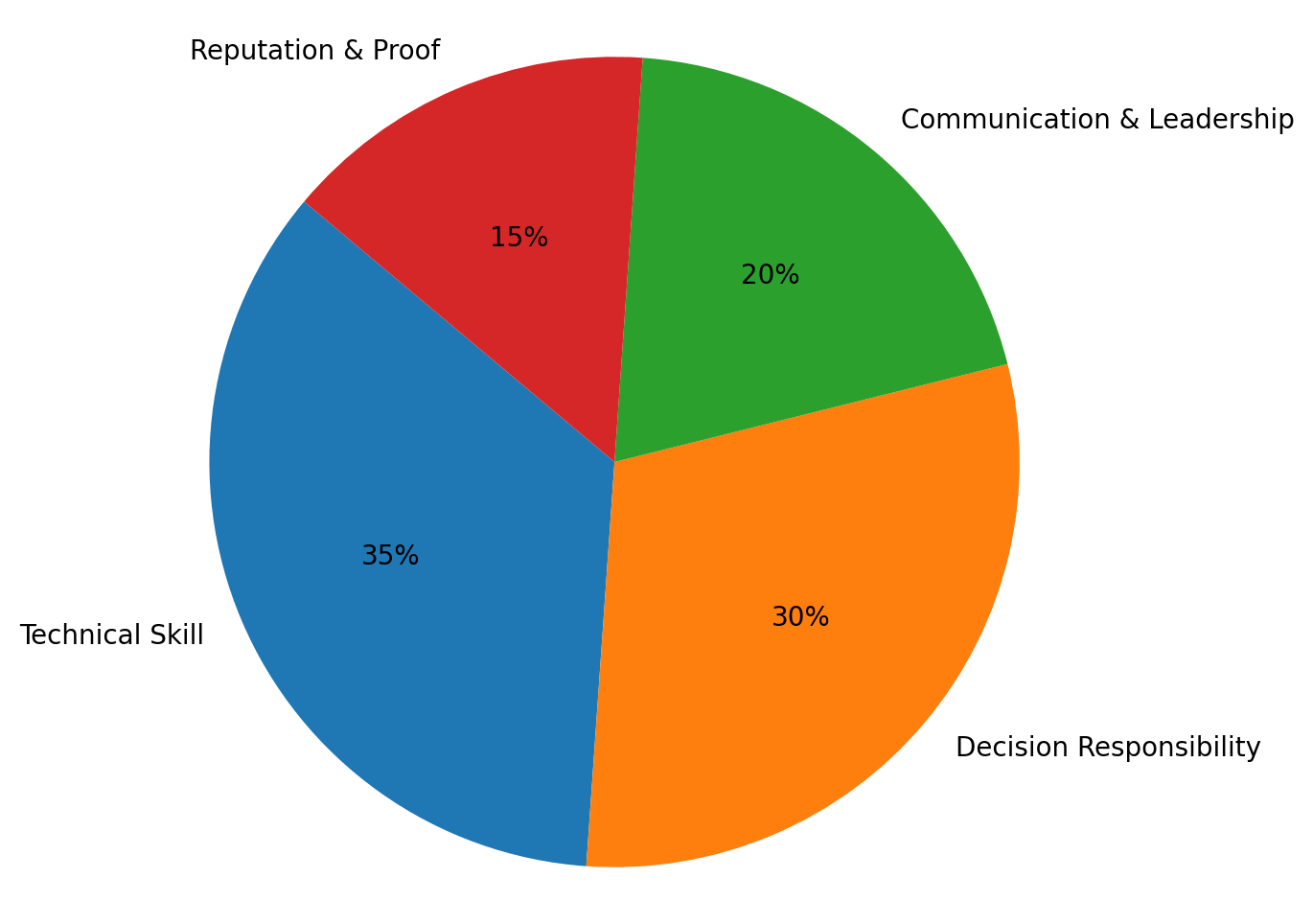
Imagine a simple pie chart for many high-paying roles:
Technical skill: 35%
Decision responsibility: 30%
Communication and leadership: 20%
Reputation and proof: 15%
Therefore, do not chase tools only. Also build judgement. Build communication too. That balance improves your chance of reaching the highest paying jobs in the world.
Closing paragraph
Chasing the highest paying jobs in the world is not about one perfect title. Instead, it is about building proof. Therefore, pick one path that fits your life. Then build skills weekly. Also show proof through projects, practice, or exams. Moreover, use UK routes like apprenticeships or bootcamps when needed. Finally, use Studyhub to stay consistent and job-ready. Do that, and you give yourself a real chance to compete in 2026 for the highest paying jobs in the world.
FAQs
It depends on location and pay mix. However, top earners cluster in law, medicine, finance, and tech. Therefore, focus on skills that scale globally.
Sometimes, yes. Tech and data can be proof-driven. Also, apprenticeships help. However, surgery and dentistry need formal routes.
Only if you can build the skills now. Otherwise, pick a stable role first. Then specialise later.
You can see skill progress in weeks. Yet job progress takes months. Therefore, commit to consistent weekly work.
The post Highest Paying Jobs in the World (2026) – Job-Ready Career Paths appeared first on Studyhub.
]]>The post How to Become a Financial Advisor in the UK appeared first on Studyhub.
]]>It often starts the same way. Prices rise, bills tighten, and people feel unsure. So, many begin asking harder questions about money. They want plans, not guesses. They want calm, not chaos. Because of that, demand for clear financial guidance keeps growing. Yet, most people still feel lost when they search for help. Meanwhile, firms need advisers who can explain choices simply. They also need advisers who can work within UK rules. If you are exploring how to become a financial advisor in the UK, you are not alone. However, you need the right route, skills, and qualifications. So, this guide shows the steps clearly. You will learn what to do first, what to avoid, and how to qualify.
Table of Contents
What a Financial Advisor Does Day to Day
A financial advisor helps people make better money decisions. In practice, you translate complex topics into simple actions. Therefore, you must listen closely and explain clearly. If you are serious about how to become a financial advisor in the UK, start by learning what the job includes.
Typical tasks include:
Reviewing a client’s income, spending, and debts
Setting goals for savings, retirement, or protection
Recommending suitable products and strategies
Checking risk tolerance and investment comfort
Writing clear suitability reports and records
Keeping plans up to date as life changes
However, the job is not only about numbers. You also manage emotions. For example, clients may panic during market drops. So, you guide them back to the plan. In short, you protect decisions from fear and confusion. That is the real value.
To finish, remember this: a good adviser makes people feel informed. As a result, clients act with confidence.
Independent vs Restricted Advice in the UK
In the UK, advisers usually work in one of two ways. Therefore, you must understand the difference early. This matters if you want how to become a financial advisor in the UK to be a real plan.
Independent advisers can recommend products from the whole market.
Restricted advisers have limits. For instance, they may use one provider set.
Here is a simple view:
Type | What it means | Best for |
Independent | Whole-of-market advice | Clients wanting broad choice |
Restricted | Limited product range | Clients happy with a set range |
Even so, both paths can lead to a strong career. However, your future options change based on this choice. So, decide with your long-term plan in mind.
To close, pick the model that fits your learning style. Then, build your skills around it.
Financial Advisor Requirements in the UK
You do not need to be “born good at finance.” Instead, you need a clear skill mix. Also, you must meet entry and compliance expectations. If you are researching how to become a financial advisor in the UK, this section is key.
Common financial advisor requirements include:
Strong communication and listening
Comfort with basic maths and data
Good organisation and record-keeping
Professional behaviour and confidentiality
Willingness to study and sit exams
Ability to explain risk in plain language
Meanwhile, employers often look for:
GCSEs and A-levels (varies by employer)
Customer-facing experience
Evidence of learning, such as short courses
A clean compliance mindset
So, if you can show responsibility and learning effort, you can enter the field. However, you must also accept ongoing study. In other words, this is a learning-heavy career.
To finish, treat “requirements” as a roadmap. Then, fill the gaps one by one.
Financial Advisor Qualifications UK: The Core Pathway
If you search how to become a financial advisor in the UK, you will see one theme. You need a Level 4 qualification recognised by the regulator to give regulated financial advice. The National Careers Service explains the main entry routes. It also lists study expectations and pathways.
A practical pathway looks like this:
Learn finance foundations
Learn the adviser process
Complete Level 4-aligned study
Work under supervision
Move into full adviser responsibilities
The National Careers Service also notes common entry options. These include university, apprenticeships, and working up from admin roles.
So, if you want how to become a financial advisor in the UK, do not jump around. Follow a staged route. Otherwise, you will waste time.
To finish, qualifications are your licence to be taken seriously. Therefore, treat them as the backbone.
How to Become a Financial Advisor in the UK
There is no single “right” route. However, some paths are faster than others. If you are weighing how to become a financial advisor in the UK, pick the route that fits your life.
Route A: University degree
A degree can help, especially in finance or business. Yet, it is not the only way. Also, it can be slower and more costly.
Route B: No degree, start as a trainee
Many people start in support roles. For example:
admin in a financial planning firm
customer service in financial services
paraplanning support
Then, they train while working.
Route C: Career change
This is common. Many switch from sales or banking roles. Why? Because they already have people skills. So, they only need the technical layer.
Quick comparison table
Route | Time to start working | Cost | Best for |
Degree route | Medium | Higher | Academic entry |
Trainee route | Fast | Lower | Earn while learning |
Career change | Fast-medium | Medium | Strong people skills |
To finish, pick one route and commit. That is how results happen.
Recommended Studyhub Courses to Support Your Route
You wanted Studyhub-aligned learning. So, here are courses that match what employers want. Use only what you need. Otherwise, you will overload yourself. If your target is how to become a financial advisor in the UK, this stack helps.
Good starting stack (beginner → adviser-ready):
Strong add-ons for credibility and progression:
Transaction Monitoring in Financial Services: Ensuring Security
Finance Law Fundamentals: Legal Aspects of Financial Transactions
To close, keep your course list tight. Then, your CV stays focused.
Financial Advisor Salary UK: What to Expect
Salary is one of the most searched topics for this career. In the UK, pay depends on experience, location, and how you are paid. It also varies by firm type and client base. Therefore, anyone researching how to become a financial advisor in the UK will want realistic figures, not hype.
According to the UK National Careers Service, financial advisers typically earn:
£23,000–£30,000 as a trainee or junior adviser
£30,000–£45,000 once fully qualified and established
£50,000–£100,000+ with experience, specialism, and a strong client book
However, these figures can change based on several factors.
Key factors that influence pay
Employment model: employed advisers earn stable salaries, while self-employed advisers rely on fees and performance
Bonuses and commission: many firms add incentives based on advice quality and retention
Client book size: recurring clients improve long-term income stability
Specialism: advisers focused on pensions or investments often earn more
Although salary matters, chasing high income too early can backfire. Instead, early advisers should focus on competence and compliance. As a result, pay rises naturally with trust and responsibility.
Typical salary progression by career stage
Career stage | Main focus | Likely income outcome |
Trainee adviser | Learning rules and supervised advice | Entry-level salary |
Early adviser | Building confidence and client base | Salary growth + bonuses |
Experienced adviser | Retention, referrals, specialism | Strong earning potential |
To close, income in this profession grows with credibility. Therefore, when trust increases, salary usually follows.

The Skills That Make You Employable Fast
Many people focus only on qualifications. However, employers look for skills they can use immediately. Therefore, if you are serious about how to become a financial advisor in the UK, you should build these skills early. They shorten the learning curve and reduce risk for employers. Moreover, they help you move from trainee to trusted adviser faster. The skills below are practical, realistic, and proven across UK firms.
Technical Skills You Must Develop
Basic financial maths
You must understand percentages, growth, and loss. For example, you should explain returns without a calculator. Moreover, you must spot errors quickly. This skill builds accuracy and confidence.Report reading and summarising
Financial documents can be long and complex. Therefore, you should practise pulling out key points. In addition, summarising helps you explain advice clearly to clients.Understanding risk and diversification
You must explain why spreading investments matters. Also, you must show how risk changes over time. As a result, clients make calmer decisions.Writing clear client notes
Clear notes protect everyone. They record discussions, decisions, and outcomes. Consequently, good notes reduce complaints and rework.
Human Skills Employers Notice First
Calm communication
Money discussions can be emotional. Therefore, staying calm helps clients feel safe. Moreover, it builds trust during difficult conversations.Honest expectation setting
You must explain what advice can and cannot do. Also, you should avoid unrealistic promises. As a result, clients stay informed and satisfied.Handling objections politely
Clients often question recommendations. Therefore, you should respond with facts, not pressure. This approach keeps discussions professional.Explaining choices simply
Complex terms confuse people. So, use plain language and examples. Consequently, clients understand risks and benefits better.
Work Habits That Speed Up Hiring
Strong time management
You will juggle meetings, reviews, and admin. Therefore, planning your day matters. It helps you meet deadlines without stress.Following rules consistently
Regulation is not optional. So, repeat safe processes every time. This habit builds reliability.Accurate record-keeping
Files must be complete and tidy. Moreover, records support every recommendation. This protects clients and your career.Continuous learning attitude
Rules and markets change. Therefore, learning never stops. Employers value advisers who stay curious and current.
Quick Self-Check
☐ explain complex ideas simply
☐ stay organised under pressure
☐ learn from feedback
☐ discuss money calmly
☐ follow rules with care
If you tick most boxes, you are on the right path.
You do not need perfection on day one. However, you do need evidence. Therefore, practise these skills in real tasks. Over time, proof replaces promises.
Common Mistakes That Stop People Becoming a Financial Advisor
Many learners fail for avoidable reasons. Therefore, avoid these early. This matters if your aim is how to become a financial advisor in the UK.
They chase salary talk first. Then, they skip the basics.
They study without a plan. So, they stall fast.
They avoid compliance. Later, they struggle at work.
They rely on jargon. Clients switch off quickly.
They depend on motivation only. Routine beats motivation.
Instead, do this:
Pick a route
Choose a tight course stack
Practice simple explanations
build evidence of learning
Apply for trainee roles early
To close, small daily steps beat big bursts.
You can access the course library of 3000+ courses for just £149 for a lifetime!
Conclusion
Becoming a financial advisor in the UK is realistic. However, it works only with structure. So, start by locking your route. Then, build the foundations. After that, move into adviser training and Level 4 learning. Meanwhile, apply for trainee roles sooner than you think. If you keep asking how to become a financial advisor in the UK, turn that question into action. You do not need to know everything first. You need to start, learn, and improve. Also, keep records clean and consistent. That habit helps later. Finally, stay steady. Because this career rewards discipline, not hype. If you want a clear learning plan, Studyhub courses can support each stage. Most importantly, think about the client. When you explain money simply, you become valuable.
FAQs
You need an FCA-recognised Level 4 qualification in financial planning. This covers regulation, ethics, investments, and pensions. Most advisers start with a Level 4 diploma, then add CPD yearly.
Typically 1–3 years. It depends on your route. Studying while working can take longer, while graduate or apprenticeship routes may be faster with structured support.
Yes, earnings can be strong over time. Trainees earn less at first, but pay rises with experience, clients, and specialism. Many experienced advisers earn well above the UK average.
Start by choosing a route: university, apprenticeship, or entry-level finance role. Then begin an FCA-recognised Level 4 qualification and apply for trainee or support roles to gain experience.
The post How to Become a Financial Advisor in the UK appeared first on Studyhub.
]]>The post What is the Average IQ Score in the UK? appeared first on Studyhub.
]]>In 2025, IQ league tables went viral again, and debates followed fast. Meanwhile, one widely shared dataset puts the average IQ in UK at about 99.12, which is close to the global norm. Forbes+1 Yet people still feel pressure, because numbers can sound like judgement. Without clear context, students worry about labels. Likewise, adults compare themselves unfairly at work. Even families second-guess learning struggles at home. Recently, UK headlines even raised ethical alarms about using genetic data to “rank” embryos by predicted traits, including IQ. The Guardian So, this guide explains what the average means, what it cannot prove, and how IQ-style insights can help spot support needs early, improve learning plans, and reduce costly mistakes in education and training.
Table of Contents
Understanding IQ and Why People Care About It
Before looking at numbers, it helps to know what IQ tries to measure. IQ, or intelligence quotient, comes from standardised tests. These tests look at things like logic, patterns, memory, and problem solving.
However, IQ is not a full picture of a person. It does not measure kindness, creativity, resilience, or practical skills. It simply gives a score that shows how someone performed compared with a large group.
People care about IQ for several reasons. First, it seems to offer a simple way to compare abilities. Second, it often appears in debates about schools, jobs, and social policy. Third, many online tests use IQ as a hook to gain attention.
Yet the real value lies not in bragging rights. Instead, it lies in understanding how thinking skills link with education, health, and opportunity across a population.
What Is the Average IQ in UK?
Most modern IQ tests set the global average at 100. Scores follow a bell curve. Therefore, most people fall between 85 and 115. When researchers look at average IQ in UK, they usually find a figure close to that global mean.
Different studies give slightly different numbers. Some suggest the average IQ in UK sits just around 100. Others place it a little below or above. The differences come from methods, samples, and test types. However, the broad message stays the same. The UK, as a whole, sits near the centre of the global distribution.
This means most people in the UK fall within the standard range. They can learn new skills, handle daily tasks, and solve routine problems with support from school and work systems.
So, the headline answer is simple. The average IQ in UK is roughly around 100, within a normal global band. The deeper story is how that score spreads across groups, ages, and regions.
IQ Ranges and What They Usually Indicate
To understand the average, it helps to see the whole spread. IQ scores cluster in ranges. Each band links to general patterns, not fixed labels.
Below 70 – significant learning difficulties
70–84 – below average range
85–115 – average range
116–129 – above average range
130 and above – very high range
These bands help educators and psychologists plan support. However, they do not lock in destiny. For example, someone in the lower range may thrive with practical training and the right environment. Likewise, a person in the higher range may still struggle without discipline, focus, and emotional skills.
Therefore, when we think about the average IQ in UK, we should see it as a central point on this curve. Many people sit around it. Some sit below. Some sit above. The curve matters more than one number.
Simple Table: Average IQ in UK by Broad Age Groups
Exact figures vary by study. Still, many sources suggest that IQ scores, when adjusted, stay fairly stable after childhood. Below is a simple example table to show how people often imagine the spread. It is not a strict measurement but a helpful picture.
Age Group | Typical Adjusted IQ Band | Comment |
Children (8–12) | 90–110 | Still developing core skills |
Teens (13–17) | 95–110 | Strong gains in reasoning |
Young adults | 95–115 | Peak test performance for many |
Adults 30–50 | 90–110 | Stable overall performance |
Adults 50+ | 85–105 | Slight change, wide variation |
In practice, the average IQ in UK remains near 100 across adult ages. However, life experience, education, and health influence how that potential appears in daily decisions and work.
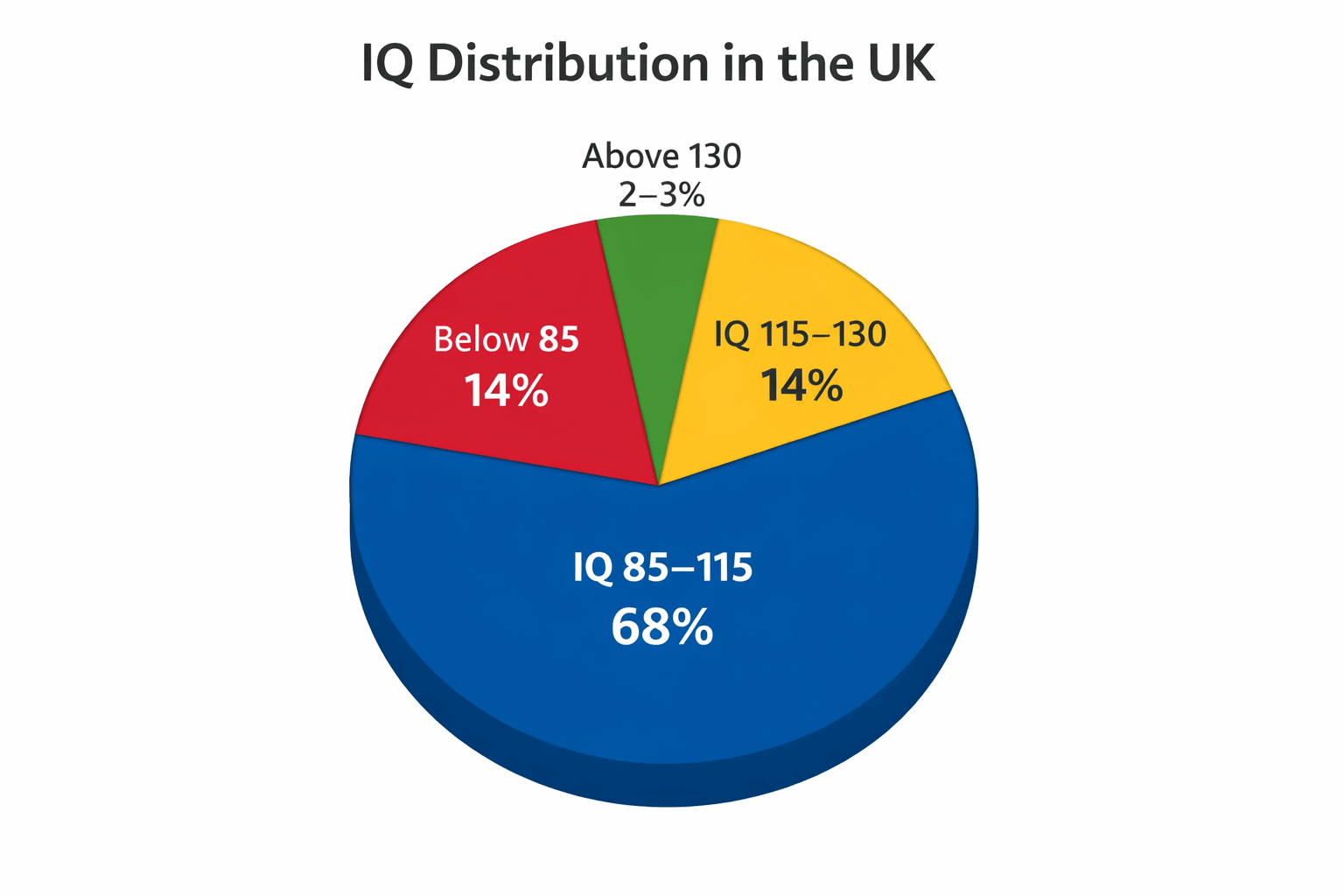
Visual Idea: Pie Chart of IQ Ranges in a Typical UK Sample
A pie chart that shows a sample of UK residents:
About 68% of the pie sits between IQ 85 and 115.
Around 14% falls below 85.
Another 14% lies between 115 and 130.
A small slice, maybe 2–3%, rises above 130.
This kind of chart helps show that most people cluster near the average IQ in UK. A few sit on either side. The shape echoes the classic bell curve but in a circular form, easy to share or explain.
How the UK Compares with Other Countries
Many people only see IQ when countries are ranked. Charts might claim that one nation is “smarter” than another. However, real comparisons are more complex.
First, different studies use different tests. Second, sample quality varies across countries. Third, cultural and language factors affect performance. For example, a test designed in one country may favour certain styles of thinking.
Broadly, the average IQ in UK tends to sit near that of other high-income countries. It may appear slightly higher than some regions and slightly lower than others. Yet the gap is often small. Education systems, childhood health, and access to books and technology matter more than a raw ranking.
Therefore, rather than asking who “wins,” a better question is this. How can the UK make sure as many people as possible reach their full thinking potential?
Factors That Influence the Average IQ in UK
The average IQ in UK does not arise from genes alone. Instead, it reflects a mix of environment, health, and education. Several key factors play a role.
1. Early childhood nutrition
Good nutrition supports brain growth. When children lack key nutrients, their development can slow. In the UK, most children have access to basic food. However, food poverty still exists. This gap can affect attention, growth, and long-term scores.
2. Access to quality education
Education builds vocabulary, logic, and problem solving. Schools that support pupils with clear teaching and safe spaces help raise overall performance. Strong literacy and numeracy programmes can shift the average IQ in UK over time.
3. Health and sleep
Sleep affects memory and focus. Poor sleep patterns can reduce short-term performance. Likewise, chronic illness, untreated hearing or vision issues, and unaddressed mental health needs can lower test scores.
4. Home environment
Homes rich in books, talk, and curiosity tend to support learning. Children who are encouraged to ask questions and explore ideas often show stronger thinking skills. Stable houses, routines, and emotional safety also support brain development.
5. Social and economic factors
Poverty, stress, and limited access to services can hold back performance. Neighbourhood safety, local libraries, and digital access all matter. As these improve, the average IQ in UK may gradually move upward.
Each of these factors does not only change a number. Instead, each shapes how people can study, work, and plan for the future.
How IQ Tests Work in the UK Context
Many people meet IQ only through online quizzes. However, official IQ tests follow strict rules. In the UK, trained psychologists usually supervise proper tests. They choose tools that are standardised and normed for relevant age groups.
Most tests contain several sections, such as:
Pattern and abstract reasoning tasks
Verbal reasoning and vocabulary tasks
Working memory exercises
Processing speed challenges
Scores are then compared with a reference group. The score shows where someone sits relative to that group. This process allows researchers to estimate the average IQ in UK in a careful way.
However, testing has limits. Cultural background, language level, and test anxiety affect results. Therefore, good practitioners never judge a person on a single score. Instead, they look at the whole pattern, plus the person’s story and strengths.
Access the course library of 3000+ courses with unlimited free PDF Certificate for just £149 for a lifetime!
Misconceptions and Myths About IQ
IQ attracts many myths. These myths can harm confidence and fairness.
Common misconceptions include:
“IQ never changes.”
In reality, scores can shift. Education, health, and practice can improve performance, especially in younger years.
“High IQ guarantees success.”
Success also needs resilience, discipline, and social skills. Many high-IQ people still struggle without these.“Low IQ means low value.”
This idea is wrong and harmful. People contribute in many ways. Practical skills, care work, and creativity all matter.“One group is naturally smarter than another.”
Differences between groups often reflect history, access, and environment, not pure ability.
When thinking about the average IQ in UK, it helps to keep these myths in mind. Numbers should inform policy and support, not fuel prejudice or pride.
Building Thinking Skills Beyond IQ Tests
Even if IQ gives a rough measure of problem solving, it does not cover every useful skill. People can grow their abilities through learning and practice. Courses, reading, and real projects can all help.
For example, learners on platforms like Studyhub UK can build digital skills, analysis skills, and decision-making skills. These courses do not change the basic average IQ in UK overnight. However, they help people use their abilities more effectively.
Some practical ways to sharpen thinking include:
Reading regularly, including non-fiction and long-form articles
Solving puzzles, logic games, and number problems
Writing reflections on news stories and workplace issues
Taking structured online courses in areas like data, business, or IT
Joining discussions where ideas are challenged respectfully
Over time, these habits strengthen mental flexibility. They also build confidence, which matters just as much as any test score.
Summary
So, what have we really learned about the average IQ in UK? The number itself sits near 100, close to the global standard. Most people fall within a broad, normal range. Small differences appear between groups and regions. However, those differences often reflect opportunity, not fixed worth.
IQ can support planning in education and health. Yet it must never define a person’s full value. Instead, it should guide support, reduce barriers, and highlight where investment is needed. When children have safe homes, healthy food, strong schools, and fair chances, the whole curve can shift.
For individuals, the message is clear. You are more than a score. You can still grow your skills through study, training, and deliberate practice. Platforms like Studyhub UK exist to help people turn potential into progress, whatever their starting point on the curve.
In the end, the real measure of a society is not only its average IQ. Rather, it is how that society treats people across the whole range, and how well it helps each person use their mind to build a better life.
FAQs
A high IQ is usually considered 130 or above. This level places a person in the top 2–3% of the population. However, a high score does not guarantee success without skills and effort.
First, IQ tests help identify learning needs so people can receive the right educational support. Second, they help psychologists understand cognitive strengths and weaknesses for planning training or intervention.
Based on several international datasets, East Asian countries such as Japan, South Korea, and Singapore often report the highest average IQ scores. However, results vary by method and data source.
IQ test scores can improve through education, practice, good sleep, and mental stimulation. Activities like problem-solving, reading, and structured learning help people perform better over time.
Research shows no meaningful difference in the average IQ of males and females in the UK. While skill profiles may vary slightly, overall intelligence levels are the same on average.
The post What is the Average IQ Score in the UK? appeared first on Studyhub.
]]>The post Disability Assessor Course: How It Helps You Upskill from Caregiver to Assessor appeared first on Studyhub.
]]>A long shift ends. A caregiver walks out of the building with aching feet and a heavy mind. They know their work matters, yet the pay still feels tight and the rota never really eases. On the way home, they notice another advert for disability assessor roles. The salary is higher, the hours look more stable, and there is even the option to work from home. The advert asks for clinical insight, empathy, and strong communication. It sounds exactly like them. At that point, the idea of taking a disability assessor course stops feeling distant and starts feeling like a real next step.
Caregivers often reach a stage where their heart still loves the work, but their body and bank balance struggle. A disability assessor course offers a way to turn that hard-won experience into a more sustainable role. In the sections below, you will see what a disability assessor does, why caregivers fit so well, and how the right training helps you switch with confidence.
Table of Contents
What Is a Disability Assessor?
Before you invest time and energy into upskilling, you need a clear picture of the role. Therefore, it helps to understand exactly what a disability assessor is and how they support people.
A disability assessor is a trained professional who examines how health conditions affect everyday life. Instead of providing hands-on care, they use structured assessments to gather information. They speak with claimants, review medical evidence, and carefully record how symptoms impact daily tasks. Then they write reports that help decision-makers decide if someone meets criteria for certain benefits.
In the UK, disability assessors often support benefits such as Personal Independence Payment and similar schemes. They do not decide who gets paid; instead, they give a clear, fair picture of each case. Many assessors start out in care roles, nursing posts, or allied health jobs. They already understand pain, fatigue, and long-term conditions, so they can ask sensitive questions with respect.
Because of this background, assessors bridge a crucial gap. They understand what life is like for people with disabilities, but they also understand the rules and frameworks. A disability assessor course helps them combine both sides in a consistent and professional way.
In short, a disability assessor still helps people, yet they do so through structured assessment, clear communication, and accurate reporting. For many caregivers, that balance between empathy and analysis feels like a natural evolution.
Why Caregivers Are Perfect Candidates for Disability Assessor Roles
When you read disability assessor job adverts, you will often spot familiar phrases. Employers want strong communication, resilience, compassion, and the ability to work under pressure. Caregivers use these skills every single day. Therefore, they are already halfway towards the role before they even start a course.
At the same time, many caregivers feel stuck on low pay and physically demanding tasks. The ladder upwards can look short. Because of that, the assessor pathway offers a realistic way to progress without losing the human side of the work.
Transferable skills caregivers already have
Caregivers, support workers, and healthcare assistants develop a powerful set of skills over time. These skills transfer directly into assessment work when they are shaped in the right way.
Empathy and listening
Caregivers understand how illness and disability affect real lives. They listen to worries about money, family, and independence. They stay patient when someone needs more time. This same empathy allows disability assessors to build trust during assessments, so people feel safe enough to share honest details.
Every shift, caregivers explain routines, medication, and changes in simple language. They speak with people who may be distressed, confused, or angry. In assessment work, clear communication is just as vital. Assessors must explain questions, outline processes, and summarise next steps without jargon, so everyone understands.
Caregivers spot small changes quickly. They notice when someone walks slower, eats less, or becomes quieter. These small signals matter. As a disability assessor, that same observational skill helps you notice how someone moves, holds objects, or responds to questions. Therefore, you can record functional impact more accurately.
Care work involves logs, handovers, care plans, and incident reports. Even if the systems are basic, you still learn to record events clearly and fairly. As an assessor, you build on this habit and write more formal reports. However, the core skill of accurate, honest documentation is already in place.
Care environments are rarely quiet. Shifts can be short-staffed, and situations change quickly. Caregivers learn to prioritise tasks, support each other, and stay calm. Assessment work also has targets and deadlines. Because of your background, you already know how to manage stress and still treat people with respect.
Together, these strengths form a powerful base. A disability assessor course does not replace them. Instead, it shapes them so they match the language, structure, and expectations of assessment services.
Gaps a disability assessor course helps you fill
Although caregivers bring many advantages, there are areas that usually need development. A focused course helps you bridge these gaps in a structured way.
Using assessment frameworks rather than instinct
In care, you often trust your gut and your experience. In assessment work, you must follow clear descriptors and criteria. A disability assessor course trains you to use these frameworks carefully, so your judgments are consistent and fair across different cases.
Care notes can be brief and informal. Assessment reports need a clear structure, neutral tone, and strong reasoning. The course guides you through sample reports, practice tasks, and feedback, so you learn how to write in a way that stands up to scrutiny.
Developing clinical reasoning and functional analysis
Instead of simply noting that someone has arthritis or depression, you must link the condition to specific daily tasks. The training helps you practise this thinking step by step. You weigh medical evidence, lived experience, and observed behaviour before you reach a conclusion.
Making balanced decisions under clear rules
You learn how to weigh different pieces of evidence without letting personal bias take over. The course introduces you to scoring systems, criteria, and thresholds. As a result, you can justify your decisions if they are ever reviewed.
Understanding documentation standards and legal duties
Assessment work involves confidentiality, data protection, and safeguarding responsibilities. Training helps you understand what to record, how long to keep it, and when to share information. This knowledge keeps both you and claimants safer.
By filling these gaps, the disability assessor course turns raw experience into a professional toolkit. You move from “I think this is right” to “I can explain exactly why this is right.”
Overall, caregivers start with a clear advantage. With structured learning, they can transform that advantage into a confident, competitive profile for assessor roles.
What You’ll Learn in a Disability Assessor Course
Before you enrol, you need to know what your time and money will actually buy. Therefore, it is useful to see the main learning areas a high-quality disability assessor course will cover.
A strong course does more than present slides and definitions. Instead, it takes you through the assessment journey as it happens in practice. Studyhub’s Disability Assessor Training, for example, is designed to mirror workplace expectations in a clear and structured way.
You can expect to explore topics such as:
Disability Assessment and the Role of a Disability Assessor
You learn what disability assessment really means, how assessors support fair decisions, and what responsibilities you will hold in daily practice. This module builds a clear foundation before you move into more detailed topics.
Legal Frameworks, Policy and Guidelines
You discover the laws, rights, and policies that shape assessment work in the UK. This includes consent, confidentiality, equality duties, and the wider purpose of structured assessments. These rules keep both professionals and claimants safe.
Disability Models and Disability Assessment Methods
You examine different models of disability and how they guide assessment choices. This helps you understand not only what you assess but why you assess it in a particular way.
Preparation for the Assessment
You learn how to prepare effectively by reviewing evidence, identifying key issues, and planning your questioning. Good preparation makes assessments smoother and more accurate.
The Assessment Process
You walk through each stage of an assessment, from first contact to closing the interview. You practise asking clear questions, exploring functional impact, and handling sensitive situations with empathy and confidence.
ICF and Disability Assessment
You explore the International Classification of Functioning, Disability and Health (ICF) and learn how it supports consistent and fair assessment. This gives you a framework for describing daily challenges in a structured, professional way.
Assistive Technology and Ergonomics
You gain insight into mobility aids, adaptive equipment, and ergonomic tools that affect daily functioning. Understanding these helps you assess how people complete tasks with or without support.
Disability Assessment Report Writing
You learn how to write clear, structured, and defensible reports. This includes organising information, using neutral language, and backing up opinions with evidence. You practise transforming assessment notes into a professional report.
In addition, you can combine this programme with related options such as Learning Disability Nursing Training – CPD Approved. That course deepens your understanding of communication, behaviour, and complex needs. Together, they create a comprehensive skill set that appeals to a wide range of employers.
By the end of your training, you should feel more confident, more structured, and better able to explain both your skills and your decisions.
Key Responsibilities of a Disability Assessor
Knowing what training covers is helpful, yet you also need to picture your daily work. Therefore, it is important to understand the key responsibilities of a disability assessor before you commit.
In most organisations, assessors carry out similar core tasks, even if the systems and forms differ. A typical workload includes:
Conducting structured assessments
You meet claimants in clinics, in their homes, or online. During each appointment, you follow a clear structure. You introduce yourself, explain the purpose of the assessment, and go through specific areas such as mobility, self-care, and work tasks.
Reviewing medical and supporting evidence
Before or after each assessment, you read through medical records and other documents. You look for diagnoses, treatment history, and specialist opinions. You also pay attention to how these details link to what the person has told you.
Asking focused, sensitive questions
You need to explore difficult topics, including pain, fatigue, continence, and mental health. The role demands tact and professionalism. You must keep the conversation on track, yet you also need to give people time to think and respond.
Writing detailed, objective reports
After each assessment, you produce a report that sets out the facts and your professional opinion. You record what the claimant said, what you observed, and how that fits with the evidence. The language must stay neutral, respectful, and precise.
Recommending outcomes within set rules
Although you may not make the final decision, you recommend how the case aligns with specific criteria. Your reports help decision-makers understand the person’s situation clearly, which is why accuracy matters so much.
Managing time, caseloads, and targets
Assessors typically work to set number of assessments or reports per week. Because of that, you must plan your time carefully and avoid leaving work to pile up. Good time management keeps pressure lower and report quality higher.
These responsibilities show that the role is people centred but also heavily process driven. A disability assessor course prepares you for both sides, so you are not surprised when you join a live team.
Ultimately, if you enjoy structured work, meaningful conversations, and clear outcomes, the assessor role can feel very satisfying.
Skills You’ll Need to Become a Disability Assessor
Training will build your skills, yet employers also look for certain qualities from the start. Understanding these expectations helps you decide whether this path fits your strengths and your goals.
Key skills for disability assessors include:
Analytical thinking
You must join dots between medical facts, daily routines, and observed behaviour. This means you cannot just repeat what someone has said. Instead, you weigh up different pieces of information and reach a balanced view.
Reports are legal records, not just notes. Therefore, you need a careful eye for detail. Small mistakes can cause confusion or even appeals. The course helps you build strong habits around checking and correcting your work.
Assessors often balance several cases at different stages. You must track what needs doing, by when, and in what order. Good organisation stops tasks from slipping and helps you meet both quality and productivity targets.
You speak with claimants who may be anxious or frustrated. You also speak with colleagues and managers. Clear, calm communication reduces conflict and builds trust. Training gives you language and phrases you can rely on.
You are expected to take a view, not sit on the fence. However, you must base that view on evidence. Good assessors can explain their reasoning and accept feedback. They see learning as part of the job, not as a threat.
IT competency and willingness to adapt
Most assessment work relies on digital systems. You must feel comfortable navigating software, entering data, and handling secure documents. Over time, systems will change, so a flexible mindset helps you stay confident.
If these skills match your strengths, a disability assessor course can sharpen them further. If some feel weaker, the course gives you a structured way to improve before you apply for roles.
In the end, successful assessors are not perfect. They are simply committed to learning, honest about their decisions, and respectful towards the people they assess.
Salary Expectations for Disability Assessors in the UK
Career decisions are not only about money, yet pay does matter. Many caregivers consider assessor roles because they want their skills and effort to be recognised financially. Therefore, it is useful to look at typical salary patterns.
In the UK, disability assessor roles often sit around the high £30,000s to mid £40,000s for full-time posts, depending on region, employer, and experience. Some positions may offer higher packages where there is extra responsibility, remote working, or unsocial hours.
In contrast, many care workers, support workers, and similar roles still earn closer to the lower end of national pay ranges. Despite this, their duties remain heavy and their emotional load significant. The difference between these pay bands can feel stark when bills rise and energy costs shift.
Because of this gap, moving into assessment can provide more breathing room, especially over time. As you gain experience and move into senior, training, or audit roles, your earnings may increase further. A disability assessor course does not guarantee a specific salary; however, it places you in a stronger position to apply for these higher paid roles.
Overall, if you want to stay in the field of disability and health yet improve your financial stability, assessor work is worth serious consideration.

Career Progression After Completing a Disability Assessor Course
A key advantage of assessment work is that it opens up several future paths. You are not locked into one job title forever. Instead, you gain a set of skills that many organisations value.
After completing a disability assessor course and gaining experience, you might move towards roles such as:
Senior disability assessor
You handle complex cases, support colleagues, and may review reports before they are finalised. This step usually comes with higher pay and greater responsibility.Clinical trainer or mentor
You design and deliver training to new assessors. You might also offer one-to-one coaching. This role suits people who enjoy teaching and explaining.Quality auditor or case reviewer
You focus on checking reports rather than writing new ones. You look for errors, tone issues, and gaps in evidence. This role supports service improvement and compliance.Remote assessor specialist
You may specialise in video or phone assessments. As digital services expand, this area can grow, especially for people who communicate clearly in virtual settings.Team leader or service manager
You oversee staff, workload, and performance. This role combines management duties with clinical insight, so previous experience as an assessor is highly valuable.
Your skills can also transfer across sectors. You might work for NHS-linked bodies, independent assessment providers, contractors delivering government programmes, or private organisations that require functional assessments for insurance or occupational health.
Because the skills you gain are portable, a disability assessor course supports not just your next step, but several possible steps after that. It becomes a foundation for a career, not just a single job move.
How a Disability Assessor Course Helps You Transition from Caregiver to Assessor
Switching roles can feel daunting. You may worry about leaving familiar teams or stepping into something completely new. However, a well-designed course reduces that fear by guiding you through each part of the change.
A disability assessor course helps your transition by:
Filling knowledge gaps with clear, structured content
You do not need to guess what the job involves. Instead, you see exact frameworks, example reports, and common scenarios. This clarity turns uncertainty into understanding.Building confidence through practice tasks
You can try out interviewing techniques and report writing exercises in a safe environment. You learn from mistakes without real-world consequences. As a result, you feel more prepared for interviews and probation.Opening doors to higher-paid, more balanced roles
With a recognised course behind you, you stand out in a busy job market. Employers can see that you are serious about assessment work, not just curious.Reducing physical and emotional strain over time
Assessment work is not always easy, yet it generally involves less lifting, rushing, and night work than many care roles. This change can support your long-term health and family life.Offering flexible and remote working options in many cases
Some assessor posts allow home-based days or fully remote contracts. This flexibility can make a huge difference if you have caring responsibilities or need to manage your own health.
Because the course addresses both skills and mindset, it turns the idea of change into a structured project. Step by step, you move from “Could I do that?” to “I am ready to apply.”
Final Thoughts
If you feel torn between your love for care work and the limits of your current role, you are not alone. Many caregivers reach a stage where they want better pay, more stability, and a new challenge, yet they do not want to abandon the people they serve. A disability assessor course offers a bridge between those feelings.
By building on your empathy, insight, and experience, the course helps you step into a role that remains deeply meaningful. You still listen, support, and advocate. However, you also gain structure, recognition, and a clearer career path. With focused training from providers like Studyhub, you can move from caregiver to assessor in a planned, confident way.
Ultimately, your experience has value. With the right disability assessor course, you can turn that value into a stronger future for yourself and the people you continue to support.
FAQs
Often, employers prefer or require a health or social care background. Nursing, allied health, or substantial care experience are common routes. However, each organisation sets its own rules, so it is worth checking job adverts in your area.
Courses from reputable providers, especially those offering CPD, show that you are investing in your professional development. While employers will still provide their own training, your course demonstrates commitment and gives you a solid starting point.
Timeframes vary. You might complete an online course within a few weeks or months, depending on your pace. Then you will need to apply for roles, attend interviews, and complete employer-specific training and probation.
Some roles are fully remote, some are hybrid, and some are based in clinics or centres. Job adverts usually state the working pattern clearly. As remote services expand, opportunities for home-based assessment work continue to grow.
You will strengthen your assessment skills, communication, and professional writing. You will also gain more confidence in clinical reasoning, time management, and working within legal and ethical boundaries.
The post Disability Assessor Course: How It Helps You Upskill from Caregiver to Assessor appeared first on Studyhub.
]]>The post How to Become a Public Health Consultant appeared first on Studyhub.
]]>Recently, several UK regions released updates showing a rise in respiratory illness, poor air quality, and pressure on local health services. Although such reports appear often, they always remind communities how quickly daily life can change when health risks grow. In one local area, for example, a council team received new data showing sharp differences in life expectancy between neighbourhoods. The room became tense as leaders realised how many issues were linked together. Yet the atmosphere shifted once a public health consultant walked them through the evidence. With calm, clear explanations, they connected the numbers, outlined realistic actions, and helped everyone understand the wider picture. Moments like this show why the role matters and why many people now want to understand how to become a public health consultant in the UK.
Table of Contents
What Does a Public Health Consultant Actually Do?
A public health consultant does not treat one patient at a time. Instead, they work at the population level. They ask questions like “Why is asthma worse in this ward?” or “Why are cancer outcomes poorer here?” Then they design and drive solutions.
Typically, a public health consultant will:
Analyse health data for whole communities.
Advise senior leaders on policies, funding, and priorities.
Lead programmes on prevention, screening, or health protection.
Coordinate responses to outbreaks or environmental risks.
Work with councillors, NHS leaders, charities, and community groups.
Moreover, the role is highly strategic. You might lead on climate and health, violence reduction, tobacco control, or vaccine uptake. You often manage teams, handle complex politics, and make tough choices with incomplete information.
Public health consultants work in many settings, including:
Local authorities and combined authorities.
NHS England and Integrated Care Boards.
UK Health Security Agency and other arms-length bodies.
Universities and research units.
Voluntary and international organisations.
Why Become a Public Health Consultant in the UK?
Firstly, the impact is huge. You influence policies that shape thousands of lives, sometimes millions. You help reduce health inequalities, prevent disease, and protect communities from major threats.
Secondly, demand is strong. The UK public health workforce is large, and the market is forecast to grow. Ageing populations, climate change, and new infectious diseases keep driving demand for skilled public health leaders.
Thirdly, the pay reflects the responsibility.
Typical salary ranges in the UK
As a public health consultant in the NHS, you will usually be on:
Role level | Typical salary range (approximate) | Source |
Public health specialty trainee | From around £49,909 | NHS Health Careers |
Consultant in public health (AfC 8d–9) | Roughly £83,000–£105,000+ | Recent NHS job adverts (jobs.nhs.uk) |
Medical consultant scale equivalent | Around £93,000+ baseline | NHS England advert |
Salaries vary between organisations and nations, yet they place you among higher UK earners. In addition, NHS roles come with strong pensions and generous leave. (findajob.dwp.gov.uk)
Finally, the work is intellectually demanding. It suits people who enjoy complex problems, big data, and long-term change.
Key Skills and Qualities
You do not need to be a genius. However, you do need a specific mix of skills. NHS Health Careers and the Public Health Skills and Knowledge Framework highlight several core attributes.
Essential skills and qualities include:
Analytical thinking
You must interpret statistics and research and still see the story behind them.Communication and influence
You explain risk, evidence, and options to non-experts, often under pressure.Political awareness
You understand how decisions are made and how to work with elected members.Leadership and negotiation
You lead multi-agency projects and negotiate with partners who disagree.Resilience and adaptability
You handle crises, setbacks, and public scrutiny while staying calm and credible.Ethical judgment
You balance fairness, cost, and evidence when resources are tight.
In addition, many public health consultants bring experience from medicine, nursing, social care, environmental health, data science, or policy roles.
Routes into Public Health Consultancy
There are two main routes in the UK. Fortunately, both medical and non-medical applicants can become public health consultants.
1. Medical route
If you are already a doctor or dentist, you can apply after foundation or equivalent training.
You will usually need:
GMC or GDC registration.
Foundation competencies or equivalent.
Evidence of interest in population health and research.
You then apply for national Public Health Specialty Training at ST1 level.
2. Non-medical route
If you are not a doctor, you can still become a public health consultant. Many do.
Generally, you will need:
A first degree at 2:1 or above, or a relevant Master’s or PhD.
Significant experience in a related field, such as epidemiology, environmental health, public policy, or global health.
You apply for the same Public Health Specialty Training scheme as medical applicants. Competition is tough. In 2024, over 1,500 people applied for about 105 places.
3. Portfolio routes and alternative paths
There is also a portfolio route to specialist registration for experienced professionals. The UK Public Health Register and Faculty of Public Health set the standards.
This route suits senior practitioners who already work at a high level and can evidence the full curriculum.

Step-by-Step: How to Bcome a Public Health Consultant
Now let’s walk through the process in practical steps.
Step 1: Explore public health and test your interest
Before you commit, you should understand what public health consultants really do.
Therefore, start by:
Reading trusted sources, such as NHS Health Careers and Prospects Public Health Careers.
Following UK public health bodies and local authority teams online.
Attending free webinars or local events when possible.
You should notice whether you enjoy thinking at system level rather than clinical level.
Step 2: Build a suitable academic base
Next, you need solid academic foundations.
For many, that means:
A relevant undergraduate degree, such as medicine, biomedical science, statistics, psychology, or social science.
Or a Master’s in public health, global health, epidemiology, or a related field.
A Master’s is highly valuable. In fact, most public health specialty trainees complete a full Master’s as part of training.
You can also start building foundations through focused online learning.
For example, Studyhub’s Public Health course introduces key concepts in a flexible way. It helps you understand health determinants, policy, and basic epidemiology.
If you want a broader risk and regulation angle, Studyhub’s Public Health and Safety course offers wider context around workplace and environmental safety.
Step 3: Gain real experience in public health settings
Admissions panels look for more than study. They want evidence that you can work in public health environments.
You could:
Work in local government public health teams.
Join health improvement or charity projects.
Take roles in data or intelligence units.
Support research projects in universities or NHS organisations.
Moreover, you should try to contribute to real outputs. For example, you might help with a needs assessment, evaluation report, briefing for councillors, or service review.
Step 4: Understand the Public Health Specialty Training scheme
Public Health Specialty Training is the main route to consultant level. The Faculty of Public Health oversees the curriculum and quality.
The programme usually lasts at least five years. It combines:
A Master’s degree in public health, if you do not already hold one.
Structured placements in local authorities, health protection, and healthcare public health.
Rotations through regional or national bodies.
Formal exams, including FPH membership examinations.
You can find detailed information on the Faculty of Public Health website, which explains entry standards and the current curriculum.
Step 5: Prepare a competitive application
Competition is fierce. Therefore, preparation matters.
You should:
Reflect on your motivation and values.
Gather strong evidence of leadership, teamwork, and communication.
Demonstrate experience using data and research to inform decisions.
Show that you understand public health ethics and health inequalities.
In addition, you must meet the formal person specification for that recruitment round. This covers academic qualifications, experience, and competencies.
Step 6: Succeed at selection tests and interview
Selection often involves situational judgement tests, written exercises, and interviews.
During these, assessors will look for:
Clear reasoning and structured thinking.
An understanding of how public health works in the UK.
Commitment to improving population health, not just personal career goals.
Ability to handle complex, politically sensitive scenarios.
You should practise explaining technical ideas, such as risk or uncertainty, in plain language.
Step 7: Complete specialty training and gain registration
Once accepted, you become a public health specialty registrar.
Over at least five years, you will:
Rotate through diverse placements.
Complete the assessed curriculum.
Pass FPH exams.
Build a portfolio of evidence that proves consultant-level competence.
At the end, you seek entry to the specialist register. This may be through the GMC, GDC, or UKPHR, depending on your background.
Step 8: Apply for public health consultant posts
After registration, you can apply for consultant roles across the UK.
Job adverts appear on:
NHS Jobs and local authority websites.
UK Government sites, such as Find a Job.
University recruitment pages and specialist boards.
You will now be judged as a senior leader. Therefore, you must show strategic thinking, system leadership, and clear public health impact.
What is Training and Working Life Really Like?
Public health specialty training is demanding yet flexible.
During training, you often:
Work regular office-based hours, with occasional out-of-hours on-call for health protection.
Join multidisciplinary teams on projects that can last months or years.
Move between organisations and locations to gain breadth.
Consultant roles themselves can be intense. However, they usually offer more predictable hours than many acute clinical posts.
You might:
Spend mornings in strategic meetings.
Use afternoons to review data, write reports, and plan programmes.
Respond to urgent issues, such as outbreaks, extreme weather events, or service failures.
Because the work is varied, you can shape your focus over time. You might lean more towards academic work, local authority policy, or national strategy.
How Studyhub Courses Can Support Your Journey
You do not need to wait for speciality training to start learning. In fact, early study helps you decide whether this path suits you.
The Public Health course from Studyhub gives a structured introduction. It covers key areas such as epidemiology, disease control, and measures of disease frequency. It also covers maternity and childbirth, environmental influences on health, health systems and policy, and the ethical issues that shape decision-making in modern practice. Therefore, it helps you speak the same language as public health teams.
The Public Health and Safety course adds another layer. It links public health thinking with workplace risk, regulation, and environmental safety. This combination strengthens your understanding of real-world hazards and control measures.
Although these courses are not replacements for a Master’s or specialty training, they:
Show clear commitment when you apply for jobs and placements.
Help you perform better in interviews and situational discussions.
Give you useful knowledge you can apply in current roles.
Is a Career as a Public Health Consultant Right for You?
Becoming a public health consultant in the UK is not quick. It demands years of study, competitive selection, and tough training. It also demands emotional resilience, political skill, and strong ethics. However, the rewards are real. You help shape healthier communities. Also, tackle unfair health gaps. You guide leaders through crises and conflicting pressures. Also, join a profession that values evidence, fairness, and long-term thinking. If you enjoy big questions, care about justice, and like working with data and people, then this path may fit you well. You can start today, at your own pace, by learning more and building your foundation.
FAQs
It usually takes 5 years of Public Health Specialty Training after meeting entry requirements. However, most applicants also have several years of prior experience or postgraduate study, so the full journey often takes 8–12 years in total.
In the UK, public health consultants typically earn £79,000–£109,000 on the Agenda for Change Bands 8d–9. Medical consultants appointed on the medical contract can start at around £93,600+, depending on location and experience.
You need to complete Public Health Specialty Training and gain specialist registration with the GMC, GDC, or UKPHR. Most applicants also hold a degree and a relevant Master’s, as well as strong public health experience.
Public health consultants in the UK mainly work for local authorities, NHS England, Integrated Care Boards, the UK Health Security Agency, universities, research organisations, and national government bodies.
You can enter through roles in local authorities, NHS teams, charities, data units, or research groups. Building relevant experience, gaining a public health qualification, and applying through NHS Jobs or local authority portals are the usual routes.
Key issues in the UK include health inequalities, chronic disease, mental health, environmental hazards, infectious disease threats, and the effects of climate change. These challenges often shape national and local public health priorities.
The post How to Become a Public Health Consultant appeared first on Studyhub.
]]>